Category: Finance & Property

  • Make space; consumerism sucks

    Make space; consumerism sucks

    One of the best quotes this year from a friend.

    People buy stuff because they can’t think of anything else better to do.

    – T. Lake

    It’s so darn true. I am guilty of turning to shopping whenever I am bored. But in a country where space (land) is a premium, we really should think hard before we buy stuff.

    I’ve ranted about consumerism not just once. I’ve spent the last few years trying to clear out junk in my house — basically things that I haven’t been using — only to have them accumulate again. Most times I am not part of the problem. I get a lot of hand-me-downs which at times are hard to simply just dispose of. I am getting increasingly frustrated that I am trying to make space, but things just keep appearing.

    I also realize that I have to spend so much more time/effort — and even money — to get rid of things than to keep or store them. This is really the biggest pain, and is really a first world problem.

    I have to spend so much more time/effort — and even money — to get rid of things than to keep or store them.

    I tried giving away computers last year. It took me months. I even had to constantly remind people to come pick them up. Some even said computers are too bulky and preferred laptops. I mean, even for free it seems people had a choice. In the end, I had to trash 3 of them.

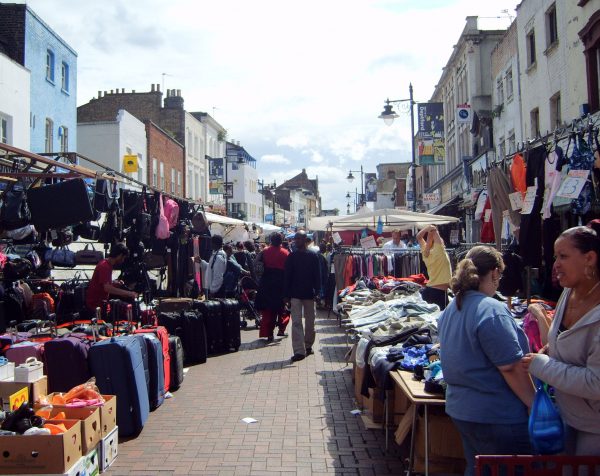
    I am compelled to think of how to solve this problem, but I don’t have an idea yet. There’s nothing an online trading platform can’t do. Just browse Carousell for used items under $10 and you will know how much junk there is out there. If only people would stop buying stuff and spend time/money on things, like social connections, knowledge, services and experiences. All the cheap online shopping from China isn’t helping at all.

    It is always an eye-opener to chat with people who newly immigrate to your country because they usually bring little or nothing with them. Pay attention to what or where they spend their time and money, and observe how much time they have because they have nothing. Be amazed that they know more about the things happening in your own country than you do.

    De-cluttering continues to be my goal, year after year. People think I’m trying to save money. Yes, it may save money if I started with less and kept it that way. But right now it actually costs money for me to get rid of things.

    Have a house full of people, not a house full of things.

    Stop buying stuff. Stop going to shopping malls. Start going to places. Start meeting people. Start buying experiences. Start living life. Have a house full of people, not a house full of things.
  • Looking back

    Looking back

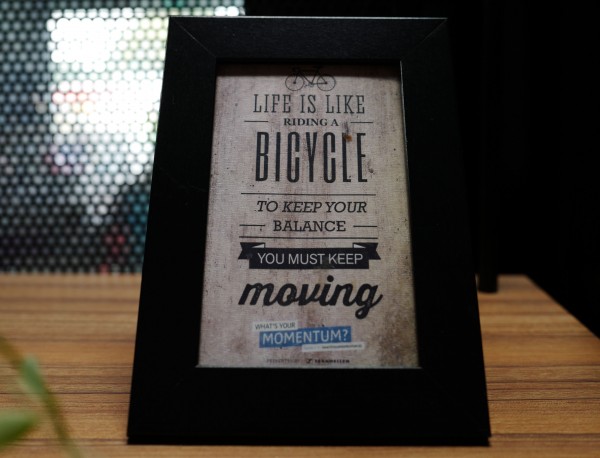
    It’s December again. How time flies. Next year marks the 10th year of my “official” life as an economic hamster. It’s starting to become obvious that the “wheel of fortune” keeps spinning, but you seem to get nowhere — until you jump off.

    I have tons of work and business related commitments. Now that I have a child, I have even less time for myself. I’m very tired and worn out.

    To most of my peers, I would probably seem to have “made it”. I may have some wealth, but at this juncture I’d really love to have some time instead to do the things I want and spend more time with the people I love.

    I never set out to work with the aim to become filthy rich. All I set out to do was to make some money so that I could do or buy the things that I want and then set aside some money as savings. Not that saving up is bad, but mindlessly hoarding money can also get out of hand pretty quickly. FYI, I found out that obsessively hoarding money can be some rich people’s hobby — some rich people don’t spend; they just store more and more to an extent they have so much money that they do not know what to do with it.

    When I first set out to work, I made barely enough for myself to get by. However, I spent my time (and money) on things that I enjoyed, such as R/C helicopters, computers, gadgets, music, games, books, etc. It may sound absurd, but these little things also helped build some of my knowledge/skills and even my (social) network. It was also one of the best times I’ve had — I would stay up on Fridays to repair my R/C helis and wake up early on Saturdays to meet friends at a “fun fly” where a few enthusiasts would gather at an open field to chit chat, share knowledge, and watch each other fly our R/C helis, crash them, then spend our Sundays buying parts and repairing them, then the week starts all over again. The point is: having something you love/are enthusiastic about makes your life meaningful and keeps your energy (“qi”) flowing.

    But I had no savings. That was the only miserable part.

    These hobbies started to take a backstage as I got busier with business and work. I knew that having no savings was bad and I have definitely come a long way from then. Today, I no longer struggle to pay my bills; I can easily afford the gadgets I want, and can even afford to have people clean my house on weekends — a luxury to most people. I’m no where near to being a millionaire of course, but the point is that I do not feel poor either.

    But what have I given up? Time. Lots of it. I have given up lots of hobbies and personal projects. I know that I am losing traction trying to keep up with technology —  the core of my livelihood. I don’t have much time with friends, and likewise they don’t have much time for me either.

    The worst part of all this is that it’s hard to get out of the spinning hamster wheel. If you jump off, you may fall and hurt yourself. The hamster wheel may also be spinning so fast that you may never be able to get back on. Slowing down is the hardest thing to do.

    I went to KK last weekend for grandma’s funeral and during my stay there I took my mind entirely off work. I spent a day chatting with my cousin whom I probably have not spoken with in 10 years. He shared about his small business (in Sarikei, East Malaysia) and how he makes just enough to get by. RM2,000 every month (S$700) would allow one to live very comfortably in his opinion. He spends his free time with family, friends and church. It seems to be the way he is going to live the rest of his life. It struck me that in a small town where life is simpler, people were indeed happier because they found the right balance between money, time, and spiritual dedication and that is the way life should be.

    It is ironic that we all trade our time to work for money, and once we have (some) money we want to trade it for time. Some people, though, use money for things that consume all their time instead (in an unfavourable manner) and that is when it gets really fucked up, and I hope none of my friends are doing that.

    Every Chinese New Year I clean my house and pull out my old R/C helis and camera equipment. I pack them in nice boxes, hoping that some day I will find time to play with them again. Year after year, I never did. Once reality sets in, you will see some of these items on Carousell.

    Right now I just want to get things I need to do done and over with so I can get them out of my head. I will use the rest of December 2015 to think through what I would like to do for 2016 and blog about it when I have a better idea.

  • Planning your property purchase

    Many people do not know that planning for a property purchase can take up to a year or more. Without proper planning, many people are stuck after making the wrong move.

    Here are some common mistakes: –

    Buying a property before knowing your budget.

    The biggest hurdle when purchasing a property is usually the loan. Not many people I know have a million bucks floating around. Most people fail to get this right because they assume they are able to obtain a loan.

    Using the current LTV of 80% and TDSR of 60%, the income required to buy a $1m apartment ($800K loan over 30 years) is around $6K assuming no other commitments. If you have some credit cards and a car loan, this figure could easily balloon to $8K.

    So what happens if you bought a new property and paid the 1% option-to-purchase (OTP) fee ($10K for a $1m property) and is unable to obtain a loan? The answer is simple: you’ll forfeit the 1% and the seller can now throw a party.

    Buying a new property before selling the current one.

    This is very common. What happens if you can’t sell your current property in time? You will be made to pay the additional 20% downpayment (your LTV is reduced to 60% from the original 80% you were expecting).

    For those hoping to apply for an ABSD remission, sorry. It’s gone.

    So why does a property purchase planning take up to a year?

    That’s because if you are unable to obtain a loan (especially self-employed), it will take up to a year to get your year-end tax filings corrected. A typical loan approval-in-principal process can take up to one month. Then you’ll start selling your current property before buying a new one to avoid any of the pitfalls I mentioned above.

    Happy house hunting.


  • Investment portfolio review

    Earlier this year I wrote about the lessons I’ve learnt and how I’ll be reshuffling my investment portfolio; the year has come to an end so it is time for my annual review.

    I’ve reduced the losses on my CPF investment. I was at -32% at the beginning of this year, and is now at -27%. This was achieved by switching out of high risk funds and then maintaining a 50/50 split between low risk Singapore-based bonds and equity funds. When the balance between them spreads ~3-5%, I use a partial fund switch to re-balance, maintaining as close to the the 50/50 split as possible.

    I’ve also significantly reduced the losses on my cash based ILF with Prudential. I applied the same technique as my CPF investments above, and will be surrendering the investment later this month as it has broken even.

    I have also had nett positive gains on my entire SGX portfolio, and will be looking to sell some positions since I anticipate another plunge early next year as oil prices fall and interest rates rise.

    I will also be reviewing my other insurance policies (for protection, not investment) this month and will write separately on this subject.

    I feel extremely comfortable now that I have established various mechanisms to track my income, expenses and assets. When I am asked specific questions about my financial health, I am usually able to provide detailed and accurate answers — this is the key to good financial management and knowledge.

    I share with my spouse, family members and close friends what I have learnt and feel happy that I am able to help others better manage their finances.

    The most important lesson learnt this year is that any form of investment requires active management.

    With that, I look forward to 2015 where I will be venturing into another major financial phase — real estate investment.

  • One year of financial progress; Tracking your net worth

    One year of financial progress; Tracking your net worth

    I’ve made effort to track my expenses over the last few years. This meant keeping a record every time I took money or a credit card out of my wallet. It is a tedious process, and gets sloppy at times.

    At the beginning of this year I set out to track my finances a little differently; I started tracking my total net worth month-to-month. Tracking net worth is much easier than tracking expenses because you only need to do it once a month. The difference, however, is that tracking net worth does not give you visibility into where exactly money is spent, e.g. food, entertainment, transport, etc.

    This is how I do it: At every start of the month, after I get my salary but before I pay my credit card bills, I keep a record of the following in an excel sheet: –

    1. Net present value of resident property less outstanding loan
    2. Net present value of investment property less outstanding loan
    3. Net present value of other assets (e.g. cars) less outstanding loan
    4. Net present value of other liquid investments, e.g. stocks, bonds, endowment, etc.
    5. Net present value of any high value personal items, e.g. jewelry
    6. Outstanding credit card debts, or other unsecured credit facilities (if any)
    7. Total cash in bank
    8. Total balance in CPF account

    * For illiquid assets, e.g. cars and jewelry, apply a fair discount of between 10-30% to its NPV.

    Then, I would create three different totals: –

    • Total of 1-8 (everything)
    • Total of 1-7 (everything except CPF)
    • Total of 2-7 (everything except CPF and resident property)

    The reason for breaking up three totals is because I do not consider CPF and residence as liquid. This will give me a good idea if I am cash rich or (illiquid) asset rich.

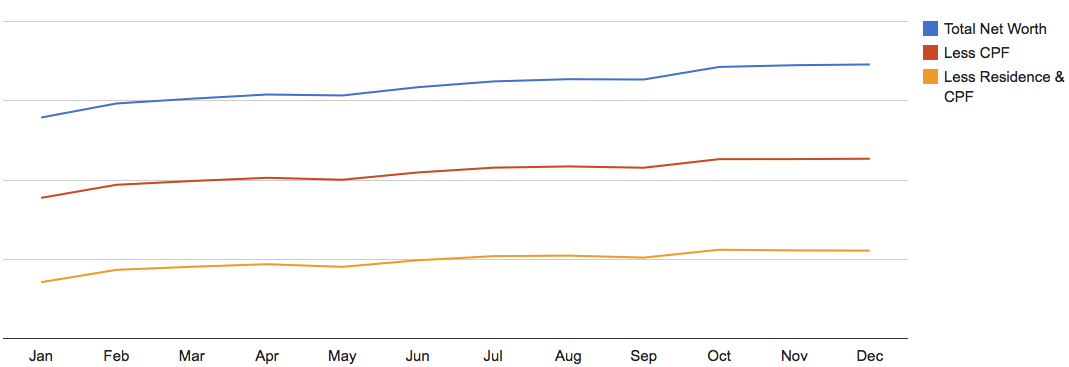
    Over a one year period, a graph like this is promising.

    Net Worth 2014

    There’s two things to note: –

    • The general trend of the graphs. If they trend upwards, I am making good progress, i.e. earning more than I spend. If they trend downwards, I am in trouble.
    • The gap between the yellow and blue lines. If this gap widens a lot, and especially if the blue line trends upwards while the yellow line starts to trend downwards, it means I may be spending too much on a potentially illiquid asset (residence) and should do something about it.

    Remember an article in The Straits Times about Singaporeans being asset rich and cash poor? I think the missing point here is that the problem only arises if the asset is illiquid. If the asset is liquid, it wouldn’t be a problem, e.g. a retiree could sell an investment property to fund his retirement.

    For those who have investments and assets, it is a good idea to start tracking your net worth to see if your asset is indeed an asset or liability. If done correctly, you should see vehicles losing value while your properties gaining value month-on-month.

    But if you have not even started tracking your expenses, you should start doing so before tracking your net worth, because detailed expense tracking will help you see where money is going so you can trim unnecessary areas of high expenditure, e.g. shopping.

    With that, I wish all my readers a happy, healthy and prosperous 2015!

  • How to buy a used car in Singapore

    I have several friends asking me for advise on their car purchases — especially used ones because the process is more complicated, so I have decided to write a guide instead of having to repeat over and over again.

    Disclaimer: Buying a car is a big financial purchase, so there are many variables to consider. You must do your own due diligence regardless of my advices/recommendations.

    Know your needs

    Ask yourself these questions:

    • Do you really need a car?
    • What kind of mileage do you do every month? Are you a going to drive a lot?
    • Do you need a 7-seater for a big family?
    • Do you often carry large and tall items?
    • Will you drive into Malaysia?
    • Will you be sharing with your spouse or siblings?
    • What other uses do you need the car for?

    All these decisions will affect the type of car you purchase. For example:

    • A travelling salesman may want a fuel economical and reliable car to reduce running costs.
    • A recreational cyclist with foldable bikes may opt for a hatchback or an SUV to fit the bikes.
    • A big family of 7 may want an MPV instead.
    • A regular traveller to Malaysia may want to avoid cars popular for theft, like Hondas and Toyotas.
    • A person sharing with his/her spouse/siblings may need to consider their needs and budget.
    • A single and lonely man may want a convertible Mini Cooper to impress the ladies at the club.

    Know your budget

    Hint: At least $1,000/month.

    A car is a big purchase, so setting a budget is important. As a general rule, the overall expenses of car ownership in Singapore starts around a minimum of $1,000/month.

    Typical expenses breakdown

    Depreciation of a typical bread and butter car (as of 2014) $6,000/yr or $500/mth
    Insurance of a first time buyer with 0% no-claims discount (NCD) $2,400/yr or $200/mth
    Fuel cost of travelling approx 2,000km/month, 12km/l @ $1.75/l $292/mth
    Parking in HDB sheltered carparks $95/mth
    Road tax for a 1,500cc (1.5L) petrol car $686/yr or $57/mth
    General servicing of vehicle every 10,000 kms $600/yr or $50/mth
    ERP (tolls), parking at the office, etc. $100 to $400/mth
    Totals $1,294/mth onwards

    Other costs to consider

    It’s easy to forget that these are also daily costs of a driving a car in Singapore: –

    • Parking at home, at work, at shopping malls, at parent’s or friend’s
    • ERP in both directions of travel
    • Traffic and parking offenses
    • In-car camera — an almost mandatory accessory in cars these days
    • Battery and tyre replacement every 2-3 years or so (rubber gets hard, so do replace them even if they are not worn)
    • Other incidentals like tyre punctures, especially if you work near construction zones
    • Unfortunate incidents such as accidents, vandalism, hit-and-run and associated repair costs
    • Car wash/grooming/beautification/”zhng”


    Understand the tax structure

    Additional Registration Fee (ARF)

    Understanding how the ARF tax works is the key to understanding how to calculate the straight-line depreciation for a vehicle in Singapore.

    • Cars less than 10 years old are usually called PARF cars because they carry a Preferential ARF (PARF) value. PARF value is a percentage of the ARF (right now it is 50%) that is given back to you if you dispose the car at the end of 10 years. This is to encourage purchase of newer and more green/efficient vehicles.
    • Cars that are 10 years or older are usually called COE cars because they no longer carry a PARF value and only carry a COE value.

    Certificate of Entitlement (COE)

    Most cars in Singapore are sold with COE unless stated by the seller. If you see the terms “body only” or “w/o COE” then it would mean the price does not include COE.

    Used Import Cars

    There are also used import cars where the registration date of the car starts before the COE hence have more complicated depreciation calculations; I would recommend a first time buyer to avoid these. Used Imports are typical with high-end sports cars, as the savings can be significant.

    There’s simply too much to cover here, so please Google and read up on these terms: OMV, ARF, PARF, PARF rebate and COE. A very detailed summary is available on LTA’s website but may be too confusing for a first timer.

    Work your sums

    Hopefully a table is easier to digest. Just add these all up.

    PARF cars COE cars
    Annual depreciation formula (Purchase Price – Min. PARF) / (No. of months of COE remaining / 12) Purchase Price / (No. of months of COE remaining / 12)
    Road tax
    Same every year Increases 10% every year, maxed out at 150% (at year 15)
    Insurance Comprehensive or 3rd party (only if not under loan) cover Mostly 3rd party cover only, i.e. does not cover your own car in an event of an accident; there are some insurers that will still provide comprehensive cover for cars between 10 to 15 years of age.
    Financing Max. 5 years, or up to remaining lifespan of COE; interest rates between 1.88-2.88% Only available for cars less than 15 years of age; otherwise usually financed using personal term loans with very high interest rates (4-5%)
    Maintenance costs Increases with car age; big ticket repairs usually starts above 5 years or 100,000 kms Same as PARF cars, increases with car age, but COE cars are even older, so will run a higher bill if anything breaks; parts may also be hard to find depending on the model of the car
    Fuel economy Similar to maintenance costs, fuel economy tends to get a little poorer when the car ages, especially if not maintained properly Similar to maintenance costs, fuel economy tends to get poorer with age, but cars built before 2000 have older engine technologies that yield even poorer fuel economy
     Safety Generally better since most cars built after 2004 should have at least an airbag and ABS Generally poorer as safety technologies improved rapidly only in the last decade

    Things to watch out for at the delaer

    Unlike new cars which usually come with a 3 or 5 year warranty, used cars dealers can be dodgy. Here’s some pointers when hunting for a used car: –

    • Don’t trust the mileage. Mileage tampering is possible and is prevalent.
    • Don’t trust the paintwork. Most dealers get a cheap single-coat respray done before cars hit the showroom.
    • Look beyond the paintwork. A car is a mechanical device and a beautiful car that doesn’t move belongs to the museum.
    • Take a careful look at the interior. Interiors are expensive to replace or repair, and will tell a story of its use/care/abuse.
    • Switch off the radio during a test drive. Pay attention to knocking, grinding, squealing or other weird noises when driving; red flag if dealer does not allow you to test drive.
    • Pay a “surprise” visit. Don’t inform the dealer that you are coming; sometimes vehicles may exhibit issues when cold (especially transmission issues), so if you tell the dealer in advance they may warm up the car before you arrive.
    • Minor issues are okay, but don’t count on the dealer making repairs for you. You will be better off asking for a discount and then getting a trusted mechanic to fix minor gremlins.
    • Be sure to ask about the loan rates, the financial institution, the payment process, admin fees (aheem, salesman commission), insurance and road tax; red flag if they offer high interest rates for “in-house” loans, high admin fees (above $500).
    • Have an experienced person help check the car for you, or at minimum have it inspected for accidents and visible issues at STA — they have laser chassis alignment measurement machines.
    • Usually the buyer pays for inspection and a deposit to the dealer should not be required; red flag if dealer insists you place a big deposit before sending the car for inspection.
    • Make sure you work your sums carefully, including the downpayment, financing, transfer fees, insurance, and even road tax.
    • Take your time and shop around, don’t be swayed by sweet talking dealers; a car is a big purchase and you should shop carefully.

    Direct owner sale

    I personally prefer direct owner sales, since I will get to really know the car’s history from the owner. Be wary though, there are many dealers masquerading as direct owners to circumvent the Lemon Law introduced in 2012. One way to tell is that they are selling on behalf of friends/family member/relatives, do not have maintenance records of the vehicle and that they also offer to help with the loan and insurance paperwork. It may be a sign that the car has some serious issue(s).

    The buyer will have to source their own insurance and loan in a typical direct owner sale, but it is not difficult these days as there are insurers and banks that offer direct applications online. The whole process may be too much cover here, and I hope to cover it in a separate article someday.

    Final words

    You’ll see that a car will cost over $1,000 a month to run in Singapore. I’m sure this will turn many potential car buyers away, but if you really need a car and you can well afford it, then do consider one as it brings significant improvement to your quality of life but do not rush into the purchase.