Tag: Net Worth

  • One year of financial progress; Tracking your net worth

    One year of financial progress; Tracking your net worth

    I’ve made effort to track my expenses over the last few years. This meant keeping a record every time I took money or a credit card out of my wallet. It is a tedious process, and gets sloppy at times.

    At the beginning of this year I set out to track my finances a little differently; I started tracking my total net worth month-to-month. Tracking net worth is much easier than tracking expenses because you only need to do it once a month. The difference, however, is that tracking net worth does not give you visibility into where exactly money is spent, e.g. food, entertainment, transport, etc.

    This is how I do it: At every start of the month, after I get my salary but before I pay my credit card bills, I keep a record of the following in an excel sheet: –

    1. Net present value of resident property less outstanding loan
    2. Net present value of investment property less outstanding loan
    3. Net present value of other assets (e.g. cars) less outstanding loan
    4. Net present value of other liquid investments, e.g. stocks, bonds, endowment, etc.
    5. Net present value of any high value personal items, e.g. jewelry
    6. Outstanding credit card debts, or other unsecured credit facilities (if any)
    7. Total cash in bank
    8. Total balance in CPF account

    * For illiquid assets, e.g. cars and jewelry, apply a fair discount of between 10-30% to its NPV.

    Then, I would create three different totals: –

    • Total of 1-8 (everything)
    • Total of 1-7 (everything except CPF)
    • Total of 2-7 (everything except CPF and resident property)

    The reason for breaking up three totals is because I do not consider CPF and residence as liquid. This will give me a good idea if I am cash rich or (illiquid) asset rich.

    Over a one year period, a graph like this is promising.
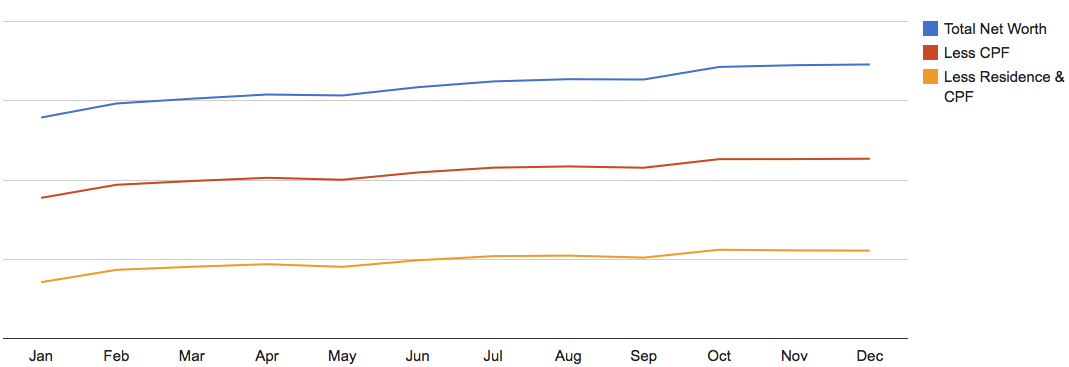
    Net Worth 2014

    There’s two things to note: –

    • The general trend of the graphs. If they trend upwards, I am making good progress, i.e. earning more than I spend. If they trend downwards, I am in trouble.
    • The gap between the yellow and blue lines. If this gap widens a lot, and especially if the blue line trends upwards while the yellow line starts to trend downwards, it means I may be spending too much on a potentially illiquid asset (residence) and should do something about it.

    Remember an article in The Straits Times about Singaporeans being asset rich and cash poor? I think the missing point here is that the problem only arises if the asset is illiquid. If the asset is liquid, it wouldn’t be a problem, e.g. a retiree could sell an investment property to fund his retirement.

    For those who have investments and assets, it is a good idea to start tracking your net worth to see if your asset is indeed an asset or liability. If done correctly, you should see vehicles losing value while your properties gaining value month-on-month.

    But if you have not even started tracking your expenses, you should start doing so before tracking your net worth, because detailed expense tracking will help you see where money is going so you can trim unnecessary areas of high expenditure, e.g. shopping.

    With that, I wish all my readers a happy, healthy and prosperous 2015!

  • Know your Net Worth

    I’m probably having what you may call the “mid-life crisis”. Screw that, probably this really is it — it is when you often sit down at the coffee shop with a cup of Kopi-O and think about all the things in life like family, kids, parents, property, car, debt, money… MONEY! The bane of human existence.

    Anyway, I’ve been thinking long and hard about money (I’m sure most of us do) and it really isn’t an easy topic to get my head around. I’m willing to bet even billionaires have problem with money. Well, not knowing where to spend it is a problem.

    Tracked your expenses yet?

    Most people start off with basic financial management by tracking their income and expenses, i.e. cash flow. That’s a good start, and if you haven’t done so I’d urge you to start right away! Ever since the proliferation of smart phones this has never been easier.

    I use a relatively simple app on the iPhone to accomplish this. It doesn’t have to be too complicated – I’d stay away from those double-entry type apps because they take quite some work to set up (unless you are familiar with accounting).

    Now that we have started to track our expenses and subsequently started to see some savings, i.e. positive cash flow, it is not uncommon for us to wonder what we want to do with that money in our bank. Should we place them in a fixed deposit, or buy some insurance policies, or buy some shares, or simply just spend some of it?

    I may not be entirely correct, but I’d like to share what I think: the next step is to know and track our net worth.

    What is net worth?

    A person’s net worth is the sum of all his assets less his liabilities. In layman speak it is all his money and things that are worth selling for money (e.g. property, car, jewelery) minus loans.

    Why is net worth important?

    I think net worth is extremely important because it takes into account of debts! It is almost impossible to escape debt in our (1st world) society. Most of us are in debt the moment we step out into the workforce with an education loan, thus it is normal for fresh graduates to start with a negative net worth.

    How to calculate net worth?

    There are lots of articles for this. Here’s one article I found useful.

    Exclude your residential property from the calculation

    If you purchased a property several years ago, you’d probably end up with a really big net worth figure. However, I suggest that the primary residential property be removed from the calculation because a residence is a basic need. Otherwise my kidneys in the black market would add a million dollars to my net worth. You get the drift.

    Be careful with fixed assets

    Don’t be overzealous with pricing out fixed assets. They are usually worth less than we think. When we need to liquidate them it would usually be in times of crisis where these assets may be literally worthless. One good example is not to take the list prices off sgCarMart for your vehicle! Discount at least 20% off that list price.

    Tracking net worth over time

    Knowing our net worth today is not enough because there are assets, investments and debts involved. Even if no new assets, investments or debts were acquired, these numbers may be affected by fluctuating interests rates or other market forces. We should aim for a positive net worth growth over time and weed out any bad assets or investments.

    In times of war, wouldn’t I be pauper?

    Duh! Even money becomes “banana money“. But worry not, if there is a next world war, Bill Gates’s net worth would have fallen too. It’s all relative.

    Debt free vs positive net worth

    While some people may advocate being debt-free, I do think that some debts are healthy because without leverage most of us would be sleeping on the streets (unfortunately). The big difference between having no debt and a positive net worth is that a positive net worth encourages leveraging with a positive advantage.

    However net worth is not to be used as the only measure of our financial situation. Cash flow must also be taken into account! A negative cash flow leads to a declining net worth! One example is buying a property with a monthly repayment that we are unable to fulfill.

    So I know my net worth, now what?

    The figure tells a lot about how you should make your next financial decision.

    For example, a person with negative net worth will need to cut down on spending or increase her income. A person with a $3K net worth should not buy a brand new Prada handbag on a credit card.

    In summary, one who is financially sound should have positive cash flow and positive net worth.

    But don’t be overly obsessed with saving up piles of cash. The old saying goes — you can’t bring money with you to the grave. If you have to spend, go ahead and spend some money. Spending is actually one way to beat inflation. But if you have to spend, spend on healthcare and life experiences, not on things.