Category: Society & Education

  • Where have the peaceful HDB estates gone?

    I haven’t been blogging for a while, so this really means something I feel strongly about to have me start writing again.

    Wifey was down with high fever over the long Hari Raya/National Day weekend. Her fever persisted for four days. It went as high as 39.5 deg C.

    Earlier this morning her fever was up again at 38.2 deg C even after a half-dosage of Panadol. Fearing it was dengue or some avian-flu thing, we drove to NUH A&E at 4am to have her X-ray and blood tests done.

    As usual it took several hours to have tests done. By the time we returned home it’s already 7am; dengue tested negative, thankfully.

    Wifey took her meds and laid down to rest while I headed downstairs for breakfast.

    Just as I got home from breakfast all ready to do some work, lo and behold, all the pounding from neighbouring renovation works started. Adding on to the pain I still have my stomping neighbour upstairs randomly banging shit around the house at night — especially over this long weekend.

    In short, I have practically no peace at any time of the day. It does not matter if I’m trying to do some work or trying to sleep after taking meds.

    This is not the first time.

    A headache was brewing from all the noise. My skull felt like a cracked egg.

    I even made a recording with my phone. Playing it back appalled me. (Question: How can I share it?)

    Where have the peaceful HDB estates gone? I don’t remember hearing neighbours stomping, renovations for weeks on end, pounding/chopping boards from housewives or noises from bamboo poles hitting against (stupid HDB design) metal railings. These are all noises I hear only after I moved to my new flat.

    I was rarely woken by external noises at my parent’s flat. The loudest thing would be my mum yelling at me to wake up, the kranguni man or the hum from the vacuum cleaner. Occasionally there would be renovation works, but not once every two months!

    Right now I can hear (if you have some faith in a musician’s trained ear) three concurrent pounding/drilling works going on.

    What is wrong with our houses? Why do people have to tear them apart and put them together over and over again. Why are people moving houses again and again? Not tired meh? Not expensive meh?

    With 20 to 30 storey HDBs built in closer and closer proximity to each other I foresee these noise issues to be even worse in newer estates.

    All these made me wonder if I should just suck on it and save up to buy a landed property with my parents or simply leave this country because of the ridiculous property and car prices.

    What good is life with no peace? Can’t work without peace, can’t sleep without peace. Heck, tell me if you can make out with your neighbours drilling. Baby bonus my ass.

    The government needs to recognise that noise pollution is a major issue in densely built up areas. Our kampung era policies don’t work anymore. If they don’t work on doing something about this and leaving it all to “community mediation” we’re going to have neighbours burn each others houses down soon.

  • Writing reinforces knowledge

    I haven’t been blogging for a while. A lot of blogging activities actually shifted to Facebook. The same goes for many of my friends who used to blog; their blogs have been deserted and their last posts date way back to 2011.

    I think that my writing is starting to suck. I can’t seem to form grammatically correct sentences or write complete paragraphs without going back to edit them again and again. I actually spend a lot of time looking through and editing my blog posts. The art of writing is starting to fade.

    I think that writing stories or articles reinforces knowledge. It helps people put ideas into words, and in turn help people verbally articulate an idea or transfer a piece of knowledge, for example when giving a presentation or when teaching/guiding a colleague.

    So to my friends who are reading this — if you haven’t blogged in a while, do find some time to do it.

    However, don’t just blog for the sake of blogging; the difference between a diary and a blog is that the former is for your own consumption, but the latter has a public element. Blogs are better used to share ideas and thoughts than one’s daily experiences, or, aheem, sexperiences.

    If there’s no intent for public sharing, then just write a diary. If you want to write a public blog then you must find pride in your writing, be willing to share knowledge and accept criticism.

  • Budget 2013 and what it means to the Singapore Car Buyer, part 2

    This is a continuum to my earlier post: Budget 2013 and what it means to the Singapore Car Buyer.

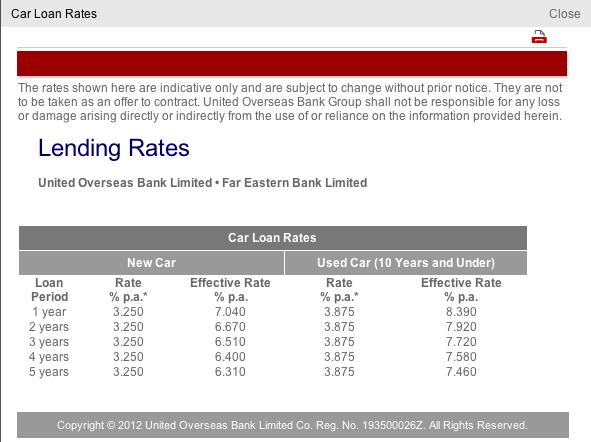
    Bank interests up

    So one of the predictions have already come true: Bank interests are up across the board. Here’s the new rates from UOB:

    The Public Transport Woes

    Many people are complaining that the new rules does not help middle income Singaporeans at all. I can empathize with them, and I can also understand why.

    A lot of my friends were driven away from public transport in the recent years because the situation has gotten really bad. In fact back in 2007 when I got my first car it was already bad. I had to commute from Bukit Batok to Tanjong Pagar and it was a crazy squeeze at the Bukit Batok station (second last stop of the North-South line) and then again at Jurong East.

    Many bit the bullet and got themselves a private transport. Truth is that the intangible benefits of car ownership can never be quantified in dollars and cents. Public transport/taxi will always be cheaper. The minimum expenditure for any car in Singapore works out to at least S$1,000 per month even if the installments are only $200. That is because running costs like insurance, road tax, parking and fuel make up about $700-800/mth. Running costs don’t vary much from car to car (unless you drive something with a big engine).

    But for those who are priced out of the market by the new rules, hang in there. More MRT lines are coming in the next few years and the government has promised to increase bus capacity. I have some confidence that they will deliver as promised.

    Used car dealers in trouble?

    This cut is very drastic. I can understand why used car dealers are complaining and coming up with alternative ways to circumvent the rules. I mentioned in the earlier blog entry that a lot of dealers took in cars at inflated prices over the past two years. Not many car dealers are cash-rich and leverage on special-rate financing for their stocks. It will not be a surprise if even big dealers wind up in the next few months.

    Hey, did we just mention leverage again? Ah, the woes of credit.

    Will MAS review this policies?

    Given the amount of noise the car dealers are making — not because they can’t find buyers but probably because all their stocks are now grossly overpriced — MAS may adjust this policy sooner than I initially suspected. If there’s adjustments, I think loan-to-value (LTV) ratio might increase by 10%.

    A bubble was growing

    I did predict a COE bubble back in 2011, albeit not in the same way that it happened. The government probably saw it coming.

    The same results, though, will apply here. I quote:

    Used car dealers will eventually be stuck with excess stock and there will be price war. A few used car dealers may even wind down due to inability to pay the financing for the cars in their showroom (they are usually on loan). Some people who lost money in the recent downward spiral of the stock market would also be forced to sell or auction their cars for cheap.

    When all these happens the prices of used cars will start to come down. People will then again flock to the used cars. But there isn’t enough new car buyers to trade in their old cars. New car dealers will be in trouble when this happens and down comes the price of COE.

    Used car dealers have had a good time for the past two years, and they created a bubble of their own by over-inflating car prices. So the question is to die now or to die later? When COE hits $100K I think would be the breaking point but it never happened.

    COE $1 a possibility

    That said, COE prices will still take a plunge. The Cat B plunge might be more drastic than Cat A due to the higher prices of Cat B cars making them out of reach to a lot of prospective buyers. There may be possibility that we’ll see $1 COE in the coming months before buyer confidence regains, so those with cars expiring in the next two years (2013-2015), prepare some cash to renew your COE when this opportunity comes. It will not come everyday.

    To wait or not to wait

    If you are still seriously considering a car, the big question is to wait or not to wait? Here’s what I think: If you are going to buy a really cheap car (under $30K) then go ahead and buy it now, provided you have done your finances. Get the car and be done with it. I think cheap cars will be snapped up really quickly as soon as the COE prices reveal its new level.

    If you are waiting to buy a higher priced car, especially something above S$100K, then hold on to your horses. You may be in for a surprise.

    Rules of affordability

    If you are still thinking of a car and unsure of whether you can afford it or not, my rules are simple.

    You either pay it full in cash, or if it is too expensive to pay in cash and you prefer to leverage, then leverage to a point whereby you are able to dispose it and stomach the loss. This 40%/50% rule makes it a no-brainer. Notice I used the word prefer, not have to, because if you have to leverage, then high chances are that you cannot afford it. It’s that simple.

    It’s a pity I am not that savvy with other markets, especially property. I would have made big bucks.

    P.S. One of the article quotes a buyer who says he can’t buy a BMW M3 and because of that wants to migrate can go and die.

  • The truth about offsetting loans with investments

    I’ve often heard people say it is easy to overcome the low car loan interest rates. While it may be 1.88%, the effective interest rate is much higher than that, about 4%.

    And people will tell me that it is easy to find something with an interest yield of 4%.

    I tell them their maths fail. Why?

    Disregarding all risks and investment yield fluctuations, simple arithmetic says that one must invest the same amount over the same period of time as the loan quantum to yield the same returns.

    This means if you took a $100K loan for 8 years, you need to plonk $100K into an investment yielding the same interest rates for 8 years.

  • Budget 2013 and what it means to the Singapore Car Buyer

    Many interesting debates sparked off when the Singapore Budget 2013 was released, but it seems the change in regulation related to the local automotive industry made the biggest impact, especially to those who have been waiting and waiting to buy a car. Those who thought there would be high number of de-registrations resulting in more COE quota and thus lower COE prices come 2016 — it came early, albeit with a twist.

    Increase in ARF

    See article: Budget 2013: New tiered tax rates for cars, rebates for commercial vehicles

    The increase in ARF is relatively insignificant at this point unless you are buying a McLaren or Ferrari. The relative change in depreciation is only half the amount of the increase, i.e. if you are paying $10K more for ARF, the increase in depreciation is only $5K more or $500/year. This is because 50% of the ARF is refundable at the end of 10 years.

    Tightening of Financial Leverage

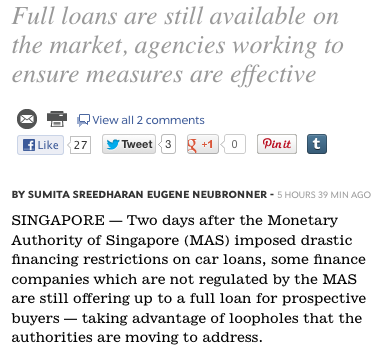
    See article: MAS to place cap on motor vehicle loans from Tuesday Feb 26

    No more 0% down payment and buying cars at pasar malam. Many middle income and fresh graduates are probably screaming that their dreams are busted.

    While I personally think 40-50% is quite extreme (30-40% would have been more manageable), I feel it is good that MAS placed a cap to enforce financial prudence. One should never buy an expensive car with no upfront cash.

    That said, I think there is a possibility that MAS will review these limits in another 1-2 years after the market has stabilized given the potential impact it may have on businesses.

    What about used cars?

    From my limited understanding, used cars are subject to the same terms: Maximum 5 years and at least 40% or 50% down payment (depending on OMV at time of registration). This means if you buy a 5 year old car, you can take a full 5 year loan with a 40% or 50% cash outlay.

    So what does this mean for the car buyer?

    Here’s what I think:

    • COE prices will drop by applying simple supply-demand mechanics; I am guessing to 2010-2011 levels or between $30-60K. This also means that new car prices will drop across the board except for very high end luxury cars with OMV exceeding $80K.
    • Loan interests will go up. The supply-demand concept does not work for auto loans because the demand is relatively inelastic. Recall in 2008 interest rates were 2.8% despite cars being cheap and demand being high. With the new rules banks lose up to 75% of their revenue and will find ways to recover them.
    • Cashback schemes and overtrades will be back with a vengeance. Interest rates for these schemes may go up to 6%.
    • Used car prices will also follow the drop in tandem with new car prices, albeit with a delay. A lot of used car dealers took in cars at inflated values over the past few years. They will have to let their overpriced stocks erode. So my advice is to wait a bit.
    • Relatively new cars purchased between late 2010 to early 2013 will suddenly lose their resale value as COE prices tumble. Owners of these cars will have to hold on to their cars longer before selling. Car modification workshops will huat.
    • Used cars above 4 years of age suddenly becomes very attractive. People who are tight on finances should look to buy older cars with much lesser initial outlay.
    • There is a possibility that older car prices start to rise due to the increased demand caused by lower cash outlay.
    • COE renewal will become viable as COE prices tumble. The cash outlay for a COE renewal versus down payment for a new car are going to match up really close. We will start to see a lot of old Nissan Sunny and Mitsubishi Lancers. Repair workshops will huat.
    • Hopefully prices of motor insurance will drop due to reduced car prices, but I think that would be fat hope.

    What can I afford?

    That said, can a person with about $8-10K of cash to spare still buy a car? Yes he/she can. A small hatchback from 2005 will give him/her an extremely low monthly installments at only S$200+.

    Now that is much more financially sound.

    In summary, the government is telling you that when COE drops to $30K it’s not for you to go buy a Ferrari, and that with S$5K in your bank don’t go and buy car.

  • 2013: Resolutions

    I like my resolutions being a bit open ended. Some people like a fixed achievement, e.g. lose 5kg, save $10,000. Those I would call goals; multiple goals can be derived from a single resolution. To me, resolutions are meant to guide you, more like a religion or a bible.

    Here’s mine for 2013:

    • Spend less, invest wisely;
    • Learn more, share more;
    • Make friends, be more compassionate;
    • Bitch less, create more;
    • Eat less, keep exercising.

    Happy New Year to all my friends and readers of this blog.

    – From a tiny corner of Singapore