Category: Society & Education

  • I hate paper

    I hate paper

    I hate paper, really. From when I was in Secondary School I always wondered why we cannot have our books on floppy disks and load them up on a computer.

    In the late 80s, the whole world switched from paper to plastic to reduce deforestation. Plastic cups and bags are more economical and easier to make, lighter to transport, and stronger for the same material density. Suddenly the whole world now wants to switch back to paper products.

    It is 20 years since the height of the “dotcom boom”. Governments, banks, insurance, telcos and other stupid corporate institutions are still sending me tonnes and tonnes of paper every day which I have to take additional effort to scan, shred and then sort into recycling bins. Some are still sending me paper letters even after I have opted for electronic distribution.

    By now electronic distribution should be the default if an institution has a customer’s email address on file. Printed paper should become a chargeable option.

    Too much emphasis has been placed on the relative security of sending information over digital medium. What is stopping somebody else from opening my letter, or the postman from delivering to the wrong mailbox? How is a signature scribbled on a paper cheque more secure than an electronic transfer authorised after logging in with a username, password and 2FA OTP?

    If you wouldn’t use a cheap lock that has the same key as a thousand other households in your neighbourhood, then you wouldn’t make a password “123456”. If you wouldn’t take a candy from a stranger, then you wouldn’t open that attachment from Amy Yip. Weeding out bad stuff on the Internet seem a bit harder, but in reality it is not much different from everything else in the physical world – especially if made an important part of early childhood education.

    The case for children

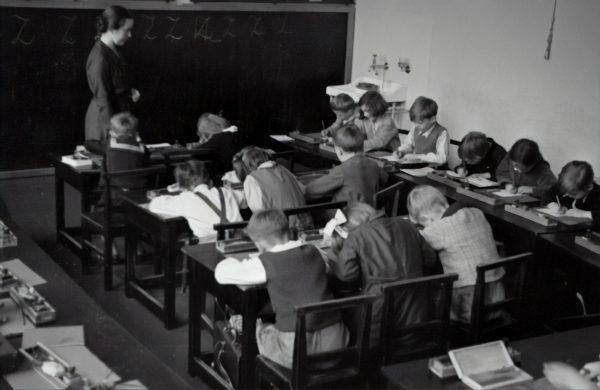
    There has been advocacy that children should have little or even no exposure to electronic devices. They need to see, feel and touch paper. They need to learn penmanship.

    No doubt it is good to have children explore the world from different angles, but let’s not kid ourselves (pun intended): our children will live in a future fully surrounded by electronic devices. Not too long ago our parents were once surrounded by print advertisements, smog generating vehicles, hand-drawn cartoons, and washed their clothes by hand. Where have those gone? Do we still carve words on stone?

    Penmanship and writing on paper is already becoming a thing of the past. Just like mechanical watchmaking and oil painting, it will become a form of art.

    Various articles seem to suggest that early exposure to electronic devices can cause ADHD, ADD or even depression. Maybe it does, but is it really the electronic device itself or the games, TikTok and social media? When I was young, I was told not to watch TV all day long. Our parents were probably told not to play marbles all day long. Is YouTube any different?

    Like it or not, all our children will likely grow up interacting with computers – if not as part of their education, then certainly as a large part of their work. Today’s artists are already using digital cameras, Adobe Photoshop, computerised music notation software, GarageBand, and a myriad of other digital tools to supplement their art. Doctors, nurses, and hospitals all depend on computers to be efficient. With the exception of maybe a Shaolin Monk – if that is what you desire.

    Children should gain familiarity with reading, typing, controlling, interacting and understanding how a computer device function. That is not to discount the need to restrict access to TikTok and YouTube, just like how we weren’t supposed to mix with certain groups of friends or have access to certain books or TV channels. The need for parental control hasn’t changed.

    Are we really saving the Earth?

    If the goal is really to save the Earth, removing plastic straws and switching to paper cups aren’t the solution. Corporations should make it a mission to aggressively reduce paper use. Governments should help drive investments into improving bioplastics.

    Of course we still need paper, but we shouldn’t deliberately avoid technology. Writing an essay on a piece of paper should hopefully be a thing of a past, but children should still do art, and I still need to wipe my ass.

    Wait, there’s bidet sprays.

    I hate paper.

  • Hiring Singaporean Software Engineers

    Hiring Singaporean Software Engineers

    I’ve been hiring Software Engineers over the past few years in Singapore, and I notice a worrying trend.

    As a local business, I always want to hire Singaporeans first; I want to give our own young people a chance; I want to see our local SMEs develop a strong Engineering culture, but recently it has become really difficult.

    One of the reasons could be because good local Software Engineers have gone to apply for Tech Giants, MNCs, banks, GovTech, etc. where they can be paid reasonably well, get good benefits, etc.

    The unfortunate thing is that small businesses and startups receive the lower percentile of the cohort, and that sucks, because these people waltz in and ask for a pretty high salary “because industry standard”.

    Bullshit. The “standard” is based on what you can do, not what others can do.

    I recently put out a job advertisement on LinkedIn, and after about a week, I received around 100 applicants; there were only 3 Singapore/PR, 2 Malaysia, 5 Philippines, 6 Myanmar, 2 China and the rest are from (you probably guessed correctly) — India.

    As a local business, plus recent COVID-19 Government incentives to favour hiring of locals (JSS, JGI), I called up all the Singaporean candidates for interview, but was met with disappointment.

    Note1: All of the candidates whom I describe below (regardless of nationality) are mostly fresh graduates with 1 year or less of work experience.

    Note2: Also, just to be clear, this is not a blog post to diss all Singaporean tech graduates. Frankly most graduates I’ve met from local universities like NUS or NTU are decent. This blog post is targeted at the “COVID-19 cohort” I encountered this year.

    I usually put candidates through a fairly simple technical quiz. It is no where close to the likes of Google and Facebook, but is effective in weeding out candidates that lack basic technical knowledge. There’s no coding; just questions and verbal answers.

    What disappointed me the most was that despite having the upper hand in terms of Government support and language proficiency, Singaporean candidates came out weaker.

    The government has actually done a good job of enticing businesses to hire locals, because they are in effect subsidising the salaries of Singaporeans, and then making foreigners expensive by increasing the salary brackets, and imposing quotas and levies.

    In addition, I like to work with locals because you see, the primary language of Singapore is English. (This is different from our national language Malay, which is purely symbolic.) Singaporean candidates are usually very conversant in English, especially those born after the 1990s. The other nationalities — especially Myanmar or China — are not so lucky; English is not their primary language, but despite their struggles, they picked it up, travelled here, took a course (such as the Graduate Diploma from NUS-ISS, which I interviewed quite a bit of applicants from.)

    I commend the effort of candidates who try their best to explain a concept in a language they aren’t familiar with. I could tell that they knew for example what a particular algorithm is about, but are unable to explain in English. They try their best, and as a recruiter, you can tell if somebody knows their shit or not.

    However Singaporeans who are naturally strong in English tend to lack actual technical understanding of many things, and instead because of their fluency in English, they are able to respond quickly with guesses, a.k.a. “smoke” — sometimes rather intelligent guesses — but that’s not what a recruiter is looking for. We don’t hire you to tikam (guess). We expect you to know your stuff. Of course I don’t expect candidates to know everything, but the fundamentals must exist.

    Sometimes after a candidate answers incorrectly, or maybe tries really hard, or makes really close guesses to the correct answer, I will share the answer and explain why, etc. Some Singaporean candidates I have come across seem nonchalant to the fact that the recruiter had actually taken an effort to explain something, and they simply answer it with a rather monotonous “oh, OK.” The better candidates would usually ask more questions, or show that they had a eureka moment.

    The other trend I noticed is that Singaporeans tend to pick the swanky Degree courses, like Cyber Security. Whilst I have no qualms with somebody taking a keen interest in this area of specialisation, it is quite impossible to learn that in a 1 or 2 year part-time Degree without even having learnt any fundamentals.

    I asked one candidate why did he pursue a Degree course. The answer is exactly what I expected to hear: “A Degree is the minimum now.”

    Let me assure you it is not — at least not in the private sector. I have hired people who have completely irrelevant Degrees but taken a bunch of Udemy courses, taken it upon themselves to work on some personal projects, and proven that they knew their stuff. A Degree makes you expensive (because you would have priced your expectations so) and that actually makes you less employable. I much prefer a candidate who has work experience than a frivolous Degree.

    ~

    So with the benefit of English proficiency, plus not having to deal with the perils of living alone in a foreign country, why do these Singaporean candidates turn out weaker?

    Wrong school/course? Should we stop letting crappy private Degree programmes be taught in Singapore?

    Not paying attention in class? Have they gone through too many years of mundane Singaporean education and grown nonchalant, uninterested and bored?

    Too comfortable? Should we maybe instead yield a higher rate of unemployment so that there’s a pressure to get better?

    I really don’t know leh.

  • Why it is not OK to lose blue collar workers

    We’re losing talent, and I think blue collar workers play an important role in our economy to produce quality work. Keeping local blue collar talent costs money, and will drive up costs of living some, but that is how things will go, especially if we want to continue to enjoy a good quality of life. People like aircon technicians, car mechanics, plumbers, etc.

    If we ignore this segment of people, sooner or later we will suffer. They say automation will replace these jobs. That’s bullshit. Robotics and automation has long ways to go before it can replace your plumber or aircon technician or mechanic. These are skilled work that is almost like the work of art. Why does the BMW factory continue to employ so many workers to build mass produced cars like the 5 series? Watch this video to understand.

    I believe one day — and the day will be soon enough — that a plumber is paid more than a developer.


  • What do we plan for?

    What do we plan for?

    Life… can be unpredictable. We make plans, we make decisions. How do we know if they were for the better?

    Only time will tell.

    Most people plan financially. It’s hard to admit it, but it’s probably the only thing we have ever really spent time planning for. How many people make more plans for their health or family than their finances? Not many. Not yet. Not at my age I don’t think.

    As age passes, I realize how important it is to spend more time with family. And also friends, of course. When I got married and bought my HDB as a young teenager, I couldn’t wait to get out of my parent’s house. I mean, every kid does, right? Parents are naggy and annoying. But ever since I had a kid, I went home every weekend so that my parents could see the little one, and it is also sort of a childcare break for me and wife. November 2015, grandma passed away. Towards the end of 2016, my dad had a pretty big heart op, and that’s when I start to realize, hey this man is getting old. You know, there’s only 52 weekends in a year.

    Money is evil. It really is. People get obsessed with it. I’m no saint either. You get some, you want more. You get more, you want even more. People spend a lifetime in search of more money. But, really, money is just an enabler. Once there’s enough to go around, the excess is just… really… excess.

    I know it’s easy to say that once we actually have money. And when we don’t, shit goes bad pretty quickly. We spend all our time trying to fix the lack of it. We get so absorbed into it that at a certain point, amongst the chaos, we will most certainly make bad decisions. That’s why the rich gets richer, and poor gets poorer.

    So I spent the last two years chasing after money — not for me, but for the company. Across my desk are two colleagues… well, friends. Old friends. Both whom I’ve asked to join the company because I thought I saw a better future for them and I believed they could do better. I’m no Bill Gates. I can’t change a million starving kids’ lives. But maybe I can help those around me.

    After years operating as a cost center, salaries have been pretty stagnant. We didn’t really pay very well to start with. I don’t want them to feel like I dragged them from one shithole to another shithole. They both have kids, and I know it’s not easy. It’s about time to turn over some profits.

    Those who know me know I hate doing sales. I’m no sales guy. I’m too honest. Too practical. Too straightforward. I can’t say yes to shit and then let the money do the talking. I hate clicking through shitty-ass bidding sites. I hate writing proposals. I hate doing cost calculations and currency conversions. I hate Microsoft Word, Excel and Powerpoint. I hate sitting in a room with pointy-haired bosses “talking business” for hours. I irritate the shit out of sales people too, because I tell people their shit sucks when it really does. That’s why I am a techie. But I did it anyway and took it as a challenge. I will be lying if I said I haven’t learnt anything new.

    So, we tried to be profitable for about 2 years, maybe coming 3 years. Then comes the 2017 year end review: It wasn’t too good. So-so. We tried our best, we won some, we lost some. But the good news is that there’s finally some money to go around for bonuses and pay raises. As the local “boss”, I had the discretion to allocate… as much as I wanted to myself! Haha.

    Nah, I did not. I gave out most of the allocated budget. I believe that the extra money would take some distraction off them, so that they can focus on work, family and friends. I know money is evil, so I try not to make it evil.

    Did this silly idea of mine really help them? Or maybe they were better off doing what they used to do? Only time will tell, I guess.

  • Spring cleaning surprises

    Spring cleaning surprises

    I wrote two entries towards the end of 2015 about slowing down (a.k.a. work-life balance) and de-cluttering.

    Enter 2016 + Chinese New Year spring cleaning. Spring cleaning this year it is a big affair because I am moving house, so almost every corner of my house gets packed.

    Here’s the top three surprises I’ve found in my home:

    1. There are more kitchen appliances than you can ever imagine. The kitchen already has a hob and a built-in oven, but then there’s also an air fryer, mini toaster oven, microwave oven, juice blender, food blender, handheld blender (for baking?), pots, pans, more pots, even more pans, tea sets, even more tea sets (I don’t even drink tea, so they have been in storage for eons), dozens of cups/mugs/salt+pepper shakers from events or weddings.
    2. There’s more gadgets than you can ever use in a day. Air filters. Fans. Radio… speakers… more speakers big and small. Earphones/headphones… lots of them. Old MP3 players, iPods, old iPhones, iPads, cameras. USB cables, power cables, even more USB cables. TVs — two of them. Ugh!
    3. There’s more cleaning products/gadgets than you ever need. Vacuum cleaners, steam cleaners (this was really a bad purchase on my part), traditional mop, high-tech 3M mop. Long brush, short brush, big brush, small brush, weird shape brush. Febreeze, Dettol, Lysol, Clorox, 3M and about a dozen other cleaning solutions.

    It’s NUTS! All the crap I bought. All the things I was made to believe work wonders when in fact all I really needed was probably a third or less of those. I sold/donated/threw a bunch of stuff away, and it was really hard to make some of those decisions, but I had to because the harder the decision, the stronger the memory. I am also making it a point to blog about this so I will never repeat the same mistakes.

    But what really surprised me was my OCD tendency to keep track of all my bank statements, bills and other documents. To my surprise, I have every single one of my bank statements since 2007. Looking back at them reminds me of my past, and tells a better story than I can even recall myself:

    I was living paycheck-to-paycheck back in 2007 and had close to no savings. I had maybe several hundred dollars balance at the end of every month (and it never grew). I remember I would look at my bank statements and make a note beside every transaction trying to figure out what it was for or where I spent my money, but a large bulk of it would be cash withdrawals at the ATM, so it was not clear if it was food, fancy restaurant meals (did not have credit card back then), cab fares or maybe even shopping.

    The turning point was when I started tracking my expenses in detail. Having an iPhone 3G (2008) and an app was key. I tracked close to every single cent I spent and saw that food expenses made up around $600/month. I tried to reduce, but it was hard because I worked in CBD, and food was (is) generally expensive. I also ate out most of the time — including dinner. My transport expenses were also high, because I occasionally cab or drive to work and had to pay crazy parking rates in town.

    I switched jobs in 2008. I worked outside of CBD but I drove to work daily and still had to pay for pretty expensive parking (averaging around $400/month) because I could not get season parking and had to pay hourly. However, food was cheap and I ate chye png almost every day for lunch and that brought my total expenses down. Together with an increase in salary, I started to see some savings, and with some excess money, I also bought basic life and health insurance.

    The rest of the story will be for another day. Anyway, as I flipped through my bank statements, I saw how this similar pattern added on to my savings bit by bit. My income has risen over the years of course, and my lifestyle may have also gotten more expensive, but the key was that my lifestyle expenses grew less than my income, and I think this is really important. Hopefully, an old friend is reading this — YOLO is not the way to go.


    I said in an earlier post that I would write about my resolutions for 2016. So here it is.

    Be grateful. I am grateful for all the people whom I’ve met along this journey, good or bad because all that has happened made me where I am today. I do hope to continue having more exciting years ahead.

    Reduce. Consumerism is scary and it will suck the life out of you. The next time I whip out my credit card, I need to think thrice. As a result, I’ve also reduced all my credit card limits. Banks are really insane these days to give out 4x your monthly salary.

    Focus. I had little distractions during the early years of my work life and it allowed me to focus on what I had to do, so I could do it right. I’ve found this very important, and the lack of focus is the reason why a lot of people fail. Not being arrogant but I do get quite a fair bit of “noise” with people approaching me to become a tech co-founder. Do not take offence if I reject you because I can’t do so many things at once; if I were your co-founder, you’d want me to focus on your stuff too.

  • Make space; consumerism sucks

    Make space; consumerism sucks

    One of the best quotes this year from a friend.

    People buy stuff because they can’t think of anything else better to do.

    – T. Lake

    It’s so darn true. I am guilty of turning to shopping whenever I am bored. But in a country where space (land) is a premium, we really should think hard before we buy stuff.

    I’ve ranted about consumerism not just once. I’ve spent the last few years trying to clear out junk in my house — basically things that I haven’t been using — only to have them accumulate again. Most times I am not part of the problem. I get a lot of hand-me-downs which at times are hard to simply just dispose of. I am getting increasingly frustrated that I am trying to make space, but things just keep appearing.

    I also realize that I have to spend so much more time/effort — and even money — to get rid of things than to keep or store them. This is really the biggest pain, and is really a first world problem.

    I have to spend so much more time/effort — and even money — to get rid of things than to keep or store them.

    I tried giving away computers last year. It took me months. I even had to constantly remind people to come pick them up. Some even said computers are too bulky and preferred laptops. I mean, even for free it seems people had a choice. In the end, I had to trash 3 of them.

    I am compelled to think of how to solve this problem, but I don’t have an idea yet. There’s nothing an online trading platform can’t do. Just browse Carousell for used items under $10 and you will know how much junk there is out there. If only people would stop buying stuff and spend time/money on things, like social connections, knowledge, services and experiences. All the cheap online shopping from China isn’t helping at all.

    It is always an eye-opener to chat with people who newly immigrate to your country because they usually bring little or nothing with them. Pay attention to what or where they spend their time and money, and observe how much time they have because they have nothing. Be amazed that they know more about the things happening in your own country than you do.

    De-cluttering continues to be my goal, year after year. People think I’m trying to save money. Yes, it may save money if I started with less and kept it that way. But right now it actually costs money for me to get rid of things.

    Have a house full of people, not a house full of things.

    Stop buying stuff. Stop going to shopping malls. Start going to places. Start meeting people. Start buying experiences. Start living life. Have a house full of people, not a house full of things.