Blog

  • CPF Minimum Sum at $155K?!

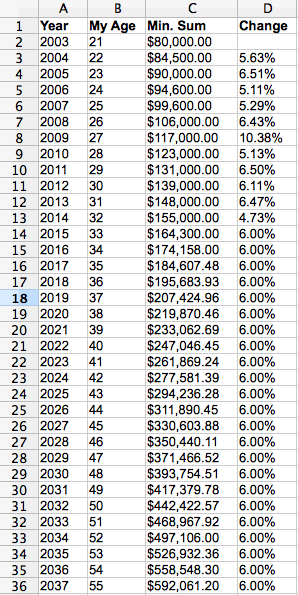
    The government just announced that the CPF minimum sum will be raised to $155K this year. Back in 2003 the min. sum was $80K.

    Minimum sum will be $600K by 2037

    Looking at this chart I came up with a very conservative 6% compound per annum, the min. sum will be almost $600K by the time I’m 55!

    I (personally) wouldn’t have met the min. sum

    Provided that I continue working till I’m 55 and am paying off my flat with CPF, I would have only accumulated approximately $370K by the time I’m 55 (including CPF interests). I’m no where near the minimum sum projection.

    The $5K max contribution limit will be raised very soon

    I strongly believe that the current max of $5K will be increased very soon because the sums just do not work out. Here’s a fictitious example of a highly paid young and energetic local graduate drawing a salary of $5K/mth so he can make the maximum possible CPF contribution from day one.

    Edit: I made some mistakes in the calculations earlier, this is an updated sheet.

    (I’m having trouble uploading graphics, will do so later.)

    He would have around $807K in his OA + SA by the time he’s 55, but check out his minimum sum! That’s provided if he doesn’t buy a property.

    But I’m sure he wants to get married and buy a flat… and have kids… the government strongly encourages that!

    He’ll have no money left in CPF if he bought a condo

    So after working for 30 years and paying for a flat together with his spouse, it is fair assumption that this bloke would have $300K less in his CPF for a decent HDB flat at current prices ($600K for a flat including interests divided equally between husband and wife).

    If the couple buys a million dollar, they will have nothing left in their OA.

    If his wife gets pregnant and stops working we may find another dead body in Bedok Reservoir/Singapore River.

    Singapore tax rate is effectively >36.5%

    Given that our current CPF rate is 36.5% (20% employee + 16.5% employer) our income tax rates can be considered to exceed 36.5%. Just as an example, the highly-paid graduate above would pay about 3% income tax for a salary of $60K/yr. This would add up to around 39.5% in taxes. This is higher than many developed countries. Even in US the highest tax bracket in the most expensive state is around 40%.

    What the hell are we still contributing to CPF? We should be contributing as little as possible.

    On hindsight, maybe it is a good idea to spend all your CPF money on a property since you’re never ever going to get it back.

    The other question would be why are we even buying older and shorter tenure properties for more money?

  • Investment portfolio reshuffle

    Earlier I wrote about the painful (and expensive) financial lessons I learnt over the last few years. I’ve been reading books and articles and will slowly reshuffle my investment portfolio.

    My current investment portfolio looks like this:

    • My nett investments are approx. 25% of my cash, i.e. if I have $20K cash, I would have $5K of investments (total $25K).
    • Around 30% of my investments are in Prudential ILFs and not doing very well.
    • The remainder are in SGX in various stocks and REITs.

    (more…)

  • Property ownership and investment in Singapore

    Living and investing in property are two different things. Being risk averse, I believe that the first home where we plan to live in should always be cheap and well within our financial comfort zone.

    The half CPF OA rule

    Apart from being able to make the down-payments and still have enough money to do a nice renovation, my real comfort zone is when my mortgage payments take less than half of my monthly CPF OA contributions — this meant that for every month I get paid, I would save an extra month in my CPF for rainy days. Relatively speaking, I should be able to fully pay off my mortgage loan in half the time, i.e. 15 years instead of 30 years. I would then be free of this debt at the age of 42.

    Sell high, buy high

    Everybody knows that the property market will be on the uptrend in the long run, but most people barely save enough to pay the first 20% down-payment. I’ve had friends who buy million-dollar condominiums as their first property and are waiting for the right time to “flip” it for a profit but little did they consider the fact that when they sell their properties they’ll have to buy another at the same exorbitant price. They either end up taking up more debt for their resident property (refer to my “comfort zone” rule above) or downgrade in either location or size to keep the profits.

    Location vs. practicality

    In my opinion, the only way to make money from property is to hold a second investment property. Investment properties have slightly different selection criteria from a resident home. For example, I may consider a SOHO unit near Bugis as an investment property but will never buy one for myself if I had a family.

    Grow money elsewhere first

    Unfortunately, most average young working Singaporean adult like myself will not have that kind of money to buy a second property, especially after the recent cooling measures introduced by the Government. Since we can no longer buy two HDB units, investors will have to turn to private properties. A small SOHO-type unit would cost upwards of $800K. If I wanted to buy a $800K private property while still servicing my existing HDB loan, I would have to cough up 40% or $320K in initial down-payments — that’s before stamp duty and GST.

    IMHO, the only way for the average Singaporean to become a property investor is to start saving and investing money early and wisely in other financial instruments first. Some may realize that property may not be the best investment afterall — who wants to pay 1% commission to agents? It’s just disgusting.

  • Financial Lessons

    Several times a year for the past few years I would revisit and update a spreadsheet that I created sometime back in 2010/2011 to track my (and wife’s) financials. It tracks our incomes, expenses, investments and assets and gives a projection of savings over a time horizon. Ever since we got married and bought a property in 2009 (with a loan, of course — as most Singaporeans do) I was concerned about the $200K+ property debt I had incurred; I worry that I may not be able to pay it off — let alone “retire” comfortably although I do not really buy the idea of a retirement. I believe in a working retirement, but this will be a topic for another day.

    The intent of this blog post is to share with you several expensive and painful financial management lessons I have learnt over the years. I know that it may be too late by the time people read this (as is usually the case) but hopefully those who follow my blog will be able to share their experiences or gain some good knowledge before shit hits the fan.

    This entry will be more of a summary since I will not be able to cover everything in a single post. I will try to write detailed follow-ups in the near future, and possibly also use this to track/share my investment moves and progress over time.

    A little history

    In 2009, I bought my current 5-room HDB flat with zero — yes $0 — COV. I was lucky to have bought it during a minor downturn in the property market. Even then, it was rare to buy a flat with no COV.

    Before I purchased my property, I set aside $10K of my CPF OA monies into Prudential Investment-Linked Funds (PruLink Singapore Managed Fund and PruLink Global Basics Fund). I was lucky (or maybe not) to have done this before the government imposed a minimum balance in CPF OA before money could be used for investments. The primary goal was to prevent HDB from taking all the money from my CPF OA for the property downpayment so I’ll have some rainy-day reserve. The secondary goal was to grow my money at a better rate than the prevailing CPF OA interest rate — as of this writing, 2.5% p.a..

    In 2010, I decided to speak to a friendly financial advisor on how to grow my savings. I bought into two Prudential endowment plans (PruFlexiCash and PruSave).

    In early 2011, I received a lump-sum payout from my business and once again approached my friendly financial advisor. I invested 30% of my cash savings into more Investment Linked Funds (ILF). The funds were distributed between a mix of global equities, bonds and commodities — something I thought to be very balanced and risk averse until the markets dipped in July/August 2011 right after I invested my money. FML.

    In late 2012, I finally got my online account for Prudential working and found out that my “investments” weren’t doing very well. In fact — they were in a mess. I switched several funds around to something that was relatively stable and growing — Singapore bonds.

    In 2013, I decided to buy some shares on SGX myself after realizing my Prudential “investments” were a load of bullcrap. Listening to my old man (who by the way is not your typical uncle trading tips with other uncles at the coffeeshop; he reads lots of books, of course including Warren Buffet’s book) and his theory of “it is never the wrong time to buy for the long term”, I bought into several shares between April and May. The government announced a bunch of cooling measures that killed a large % of my real estate shares and then a big market slide in September dealt a second blow. It’s the 2011 deja-vu. How unlucky can I get?

    Fast forward to 2014

    My flat has since gained approx. 38% in (unrealized) asset value but I ain’t going to sell it just yet. However if I do sell it, the nett gain after deducting interests would probably be somewhere around 25%.

    My CPF “investment” was at -36% of its original value before I switched funds in 2012. As of this writing, it has improved but is still at a miserable -32%. This is after 5 years!

    I also learnt that my endowment plans pay hefty commission charges and may possibly not yield the projected 3-7%, but forgoing it early would mean massive losses so I’m just keeping it for the sake of keeping it. Premiums paid-to-date (after exactly 4 years) are around $26K but the current value of the policies are only around $13K. That is almost 50% of losses for early surrender.

    My cash investment-linked funds from 2011 are at -8.3% its original value as of this writing. This is after waiting it out for more than 2 years. It was even worse prior to me switching to bonds in late 2012.

    My SGX shares are at -6% of its original value as of last week when STI fell below 3,000. But after adding dividends this turns out to be not too bad — my losses are around -4% nett considering that I entered at a really bad time near the peak of 2013 when STI was >3,400. I take this 4% loss as “school fees”.

    So with 4 years of crappy financial management, I asked myself if I could have done better.

    Summary of lessons learnt

    Not all debts are bad. I believe most articles on financial prudence would advise against debt, but it is near impossible for a young working couple to own a home in Singapore without a loan.

    Don’t trust your friendly financial adviser. Even if he meant well, the training he had received may not.

    Endownment plans are bullcrap unless you are the sort who does not know how to save, then it forces you to save (somewhat).

    ILFs are the ultimate garbage. The commission charges will kill you.

    As a summary of the three points above, never trust somebody else to manage your money for you… well… because it’s not their money.

    The one thing I am not sure about yet is the stock market which I will learn about and experiment with over the course of the next one year.

    Stay tuned for further updates…
  • Ushering in 2014

    2013 has been yet another crazy year, although much better than 2012. A summary of what I have learnt in 2013: –

    • Patience is a virtue, especially when driving. (Easier said than done.)
    • If you ask, you shall receive.
    • Expectation is a bitch. Expect less and you may be happier.
    • In order to grow yourself you need to grow those around you.
    • Regrets are meaningless. Instead take them as lessons learnt and make the best of it.
    • Money is a tool. Use it to buy more experiences, not things.
    • Stock markets are dominated by computer bots. Be weary. Do not trust reports from trading firms.
    • It’s never too early to plan your finances. Track income & expenses in detail. Document your net worth monthly.
    • Healthy food costs more, unfortunately. If you can afford it, eat healthier instead of getting a $60 haircut. I went to QB house for the entire of 2013.

    Plans for 2014: –

    • New house — hopefully to regain some sanity.
    • New member of the family (fingers crossed).
    • Continue growing myself and people around me.
    • Learn to be more focused.
    • Learn to be more positive.
    • Make more friends.
  • Wheel upsizing and ride lowering – why you are doing it wrong

    Wheel upsizing (wider tyres + larger rims + wider offsets) and ride lowering are very commonly seen vehicle modifications. Many do so primarily for aesthetics and do not understand how these modifications affect handling. They think or hearsay they are improving their vehicle handling, but they are not.

    When tyre widths and wheel offsets change, suspension geometry is altered. Handling can be, and is almost always (if done cheaply) affected negatively — unless the manufacturer had set up the suspension poorly to start with.

    Price, size or performance? Choose two.

    Wider tyres can provide more grip but hurt fuel economy. The fact is that most people barely drive their vehicle to its limits. Worse even, some upsizers may compromise with cheaper tyres as larger tyres are significantly more expensive, so the effects of wider tyres may be completely negated by cheap tyres.

    Adding on to the list of grave mistakes, many actually ditch their heavy but sturdy stock wheels and opt for cheap wheels that are touted to be light, hence fuel economical. Little did they know these cheap lightweight wheels may crack easily. Good quality forged wheels are extremely expensive.

    Assuming all goes well and high quality rims and tyres are purchased, the list of mistakes do not end here.

    The usual theory goes: wider track and lower car = better handling, right? Not entirely correct.

    Here’s why.

    1. Wider track causes softer suspension. When wheels (offset) go further outboard, load on the suspension increases and as a result the ride becomes softer. To compensate, stiffer shocks and springs are needed. BMW, for example, would sell cars with staggered and non-staggered wheels. When opting for a staggered setup, the rear track becomes narrower because the staggered rear wheels are heavier. This compensates for suspension loading and also reduces understeer (wider front track = less understeer). Unknowing BMW drivers who opt to use spacers on the rears instead of installing proper staggered wheels are actually making their handling worse.

    2. Lowering springs? Need new shocks. When lowering springs are used without matching shock absorbers, the shock absorbers will wear prematurely and not perform optimally. Shock absorbers are designed to work within a nominal ride height and lowering causes it to work outside of its designed parameters. Lowering springs are also typically stiffer to prevent the lowered car from bottoming out easily. Shocks and springs that are mis-matched will result in a bouncy or unsettled ride. Again, this negatively affects handling.

    3. Rubbing fender? Too low! Wider offsets and excessively lowered rides may cause wheels to rub against fenders. When most people experience a rubbing problem, they tend to return to the tyre shop. The solution offered is usually a recommendation for lower profile tyres or sometimes even narrower tyres resulting in stretched sidewalls. Doing so affects the speedometer, odometer and fuel economy readings. The right thing to do is to raise your ride height and get a proper set of coilovers.

    4. Bottoming out? NEVER use spring stiffeners! Excessive lowering and poorly set up suspension will cause the vehicle to bottom out easily. That’s because most lowering springs are not very much stiffer than stock springs and cannot cope with the extra load and reduced travel. I have heard of “spring stiffeners”. These are basically blocks or “retainers” sitting in-between several coils of springs preventing them from compression. Doing so is NOT recommend — for your own safety! It will cause uneven stress across the spring and a broken spring can be disastrous. Get a proper set of coilovers!

    5. Lowering can actually lead to more roll. Most people do not understand the relation between roll center, instantaneous center and CG. When a vehicle is lowered, the CG of a vehicle may be lowered but the roll center could actually move further away from the CG. This creates an increased lever effect making the car roll more even though it is closer to the ground. The result is sluggish handling. The easy fix is to install stiffer suspensions but that has an effect on tyre load. The ideal fix is to correct the vehicle roll center by modifying suspension arms.

    6. Increased track? Steering and braking may be compromised. When track width is increased, scrub radius is reduced especially for FWD/McPherson strut vehicles with -ve scrub. A small change in scrub radius can significantly alter steering feel and braking stability. The change in steering weight or sensitivity (“twichiness”) is usually mistaken for better handling. Most will never realize that they may have also compromised braking stability because it is never tested.

    7. Excessive lowering causes camber issues. Most road cars do not have adjustable camber in the front. Without compensating for the increased -ve camber when lowering, tyres are subject to premature inboard wear. Change in camber can also affect a vehicle’s understeer/oversteer character, especially for cheaper FWD cars with torsion beams in the rear — camber angles do not change at the back when lowered. Excessive lowering will even cause +ve camber gain on most vehicles with McPherson strut front suspension. This will cause cars to actually flip over in an aggressive corner. Here’s a video I found on YouTube showing how the camber changes across suspension travel.


    Strut Suspension Camber Behavior.

    To properly lower a vehicle and increase its track width, a lot of modifications are required and mostly requires a complete overhaul of the suspension components. For most people, it’s just not worth the money.

    The cheapest way to improve handling on a normal day-to-day vehicle is to install a good set of tyres and proper brake pads. Most stock brake pads are too soft (adhesive type) because they are designed to work in cold (read: snow) weather. We do not have cold weather here in Singapore. Switching to a harder (abrasive type) pad will drastically improve braking performance. The only downside is that the brake rotors will wear faster and the brakes might squeal if not bedded in properly. Also ensure tyres are properly inflated — it makes a world of difference.

    Tyre inflation tip: Add more pressure to the front tyre and reduce in the rear. Most cars, even RWD ones, are designed to understeer right out of the factory. A slight change in pressure (+/- 2psi) will alter its handling character.

    I hope this has benefited you and saved you some money you should never have spent. Safe motoring!