Blog

  • Know your Net Worth

    I’m probably having what you may call the “mid-life crisis”. Screw that, probably this really is it — it is when you often sit down at the coffee shop with a cup of Kopi-O and think about all the things in life like family, kids, parents, property, car, debt, money… MONEY! The bane of human existence.

    Anyway, I’ve been thinking long and hard about money (I’m sure most of us do) and it really isn’t an easy topic to get my head around. I’m willing to bet even billionaires have problem with money. Well, not knowing where to spend it is a problem.

    Tracked your expenses yet?

    Most people start off with basic financial management by tracking their income and expenses, i.e. cash flow. That’s a good start, and if you haven’t done so I’d urge you to start right away! Ever since the proliferation of smart phones this has never been easier.

    I use a relatively simple app on the iPhone to accomplish this. It doesn’t have to be too complicated – I’d stay away from those double-entry type apps because they take quite some work to set up (unless you are familiar with accounting).

    Now that we have started to track our expenses and subsequently started to see some savings, i.e. positive cash flow, it is not uncommon for us to wonder what we want to do with that money in our bank. Should we place them in a fixed deposit, or buy some insurance policies, or buy some shares, or simply just spend some of it?

    I may not be entirely correct, but I’d like to share what I think: the next step is to know and track our net worth.

    What is net worth?

    A person’s net worth is the sum of all his assets less his liabilities. In layman speak it is all his money and things that are worth selling for money (e.g. property, car, jewelery) minus loans.

    Why is net worth important?

    I think net worth is extremely important because it takes into account of debts! It is almost impossible to escape debt in our (1st world) society. Most of us are in debt the moment we step out into the workforce with an education loan, thus it is normal for fresh graduates to start with a negative net worth.

    How to calculate net worth?

    There are lots of articles for this. Here’s one article I found useful.

    Exclude your residential property from the calculation

    If you purchased a property several years ago, you’d probably end up with a really big net worth figure. However, I suggest that the primary residential property be removed from the calculation because a residence is a basic need. Otherwise my kidneys in the black market would add a million dollars to my net worth. You get the drift.

    Be careful with fixed assets

    Don’t be overzealous with pricing out fixed assets. They are usually worth less than we think. When we need to liquidate them it would usually be in times of crisis where these assets may be literally worthless. One good example is not to take the list prices off sgCarMart for your vehicle! Discount at least 20% off that list price.

    Tracking net worth over time

    Knowing our net worth today is not enough because there are assets, investments and debts involved. Even if no new assets, investments or debts were acquired, these numbers may be affected by fluctuating interests rates or other market forces. We should aim for a positive net worth growth over time and weed out any bad assets or investments.

    In times of war, wouldn’t I be pauper?

    Duh! Even money becomes “banana money“. But worry not, if there is a next world war, Bill Gates’s net worth would have fallen too. It’s all relative.

    Debt free vs positive net worth

    While some people may advocate being debt-free, I do think that some debts are healthy because without leverage most of us would be sleeping on the streets (unfortunately). The big difference between having no debt and a positive net worth is that a positive net worth encourages leveraging with a positive advantage.

    However net worth is not to be used as the only measure of our financial situation. Cash flow must also be taken into account! A negative cash flow leads to a declining net worth! One example is buying a property with a monthly repayment that we are unable to fulfill.

    So I know my net worth, now what?

    The figure tells a lot about how you should make your next financial decision.

    For example, a person with negative net worth will need to cut down on spending or increase her income. A person with a $3K net worth should not buy a brand new Prada handbag on a credit card.

    In summary, one who is financially sound should have positive cash flow and positive net worth.

    But don’t be overly obsessed with saving up piles of cash. The old saying goes — you can’t bring money with you to the grave. If you have to spend, go ahead and spend some money. Spending is actually one way to beat inflation. But if you have to spend, spend on healthcare and life experiences, not on things.

  • BMW Buyer vs Public Transport Fan?

    I read this article and couldn’t resist my urge to bang wall.

    http://ride.asiaone.com/features/opinion/story/bmw-buyer-versus-public-transport-fan

    Comparison of extremes

    First, the example of an expensive $220K BMW 3-series is a little way off the charts as a basis for comparison against public transport. The author could have used a cheaper car, for example, a Kia Forte (which is a very decent family sedan, by the way.) He also failed to mention that a secondhand car market actually exists. Willful omission?

    And for a $2,000/month installment, assuming this is over 10 years, then $240K is the full amount including, not excluding, interests. The author seems to be clueless about the tax structure and rebates. (Business Times article, really?)

    The author also seems to have conveniently forgotten about all the recent complaints about queueing, waiting, squeezing, breakdowns, smelling people’s armpits, getting drenched in the rain, having people rub you all over, getting scolded by random aunties and having uncles with a laptop watch porn withbeside you.

    Where the hell are the taxis when you needed them most?

    Has anybody also forgotten about SARS?

    Can you or do you really want to bring a family of 5 onto a crowded bus with bags of groceries?

    What about the time and opportunity losses of the aforementioned Public Transport Fan (“PTF”)?

    There is indeed “a huge price to pay for convenience.”

    Anyway, let’s just take that as that, and that the BMW driver has a $340K hole in the bank as the author of the above article described.

    Invest, invest, invest!

    The author brought up investing! Why am I not so damn surprised?

    I haven’t seen my investments yield as much as the author has described. The truth is there are risks associated. The markets have been very volatile for the past four years, and I do not see it correcting anytime soon. All I can say is, invest with care.

    And for a regular investment of $2,000/month, a 3-4% dividend yield would return $720 every year. That is per year! Or about $60 per month.

    Condo… in Pulau Ubin?

    And as described by the author, if these dividends have been reinvested, i.e. with the effect of compound interest, the eventual sum of $999K would buy the PTF a piece of “suburban condominium” in 25 years. Really? With all the talk about investments, what ever happened to inflation?

    Anyway, I will put this theory to the test. I am investing fixed monthly sums into dividend yielding stocks starting this year. My portfolio should be growing as quickly, or even more quickly than my car installments. Unlike some book or article writers, I walk the talk.

    Will you really save that $2,000 a month if you didn’t drive a car?

    Sometimes money that goes around comes around. If you don’t spend on one thing, you end up spending on another — food, clubs, branded goods, gadgets, etc. Sure, maybe you won’t spend all of that 2 grands, but some of that is going to be spent somewhere, somehow.

    Public transport (and Taxi for that matter) will always be cheaper. Private transport is a lifestyle choice. If you are single, maybe it’s still OK. For those with a family, sometimes a car can really be of much help.

    And for those looking for a girlfriend… need I say more? πŸ˜‰

    Just for laughs:

    Just for Laughs - Where's your F***ing Ferrari?

  • On car loans again

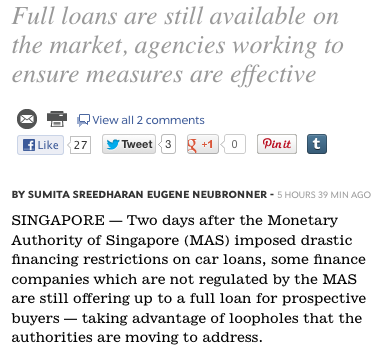
    I just read this article.

    I found this statement by Tan Huey Min, general manager of Credit Counselling Singapore a little misleading:

    Over the long run, if you pay off the loan in eight years, the amount you have paid is much more than if you had paid the loan off in five years.

    First off, back when 100% 10-year loans were allowed, the interest rate was 1.88-2.8%. EIR 3-4%.

    Now that MAS capped loans to 50% 5-year, banks raised interest rates to 3.25%, or EIR 6-7%.

    Given an arbitrary amount of $100,000. This is how it works out:

    10 years, 100% loan @ 1.88% = $18,800 in interests
    5 years, 50% loan @ 3.25% = $8,125 in interests

    Sure, the interests would have reduced by over $10k+ but these have not taken into account the time value of money, i.e. inflation.

    Singapore’s inflation rate averaged around 4% over the last 5 years. Given that the old EIR was 3-4%, it was actually cheaper to take the loan.

    Note also when you stretch a car loan, the real EIR decreases.

    Here’s what $50K (the down payment amount) if hedged against inflation would work out over 5 years at 4%:

    $50,000 (P) x 4% compounded (r) x 5 years (Y)
    Future value = P(1 + r)^Y = 50000 x (1.04)^5 = $60,832.65

    Amused? No. It is exactly that. The interest rates have risen taken into account the reduction in banks profits.

    So to the cash-rich savvy investor, down paying 50% may not make sense with the revised interest rates then.

    However, if one does not invest wisely, sure… avoiding the debt would be good.

    Now with this blog post I did not say to go right now and take a full loan on a car while you still can. Taking on loan with leverage need to be weighed against risks. The most important risk to manage is the ability to bail out at any time.

  • Writing reinforces knowledge

    I haven’t been blogging for a while. A lot of blogging activities actually shifted to Facebook. The same goes for many of my friends who used to blog; their blogs have been deserted and their last posts date way back to 2011.

    I think that my writing is starting to suck. I can’t seem to form grammatically correct sentences or write complete paragraphs without going back to edit them again and again. I actually spend a lot of time looking through and editing my blog posts. The art of writing is starting to fade.

    I think that writing stories or articles reinforces knowledge. It helps people put ideas into words, and in turn help people verbally articulate an idea or transfer a piece of knowledge, for example when giving a presentation or when teaching/guiding a colleague.

    So to my friends who are reading this — if you haven’t blogged in a while, do find some time to do it.

    However, don’t just blog for the sake of blogging; the difference between a diary and a blog is that the former is for your own consumption, but the latter has a public element. Blogs are better used to share ideas and thoughts than one’s daily experiences, or, aheem, sexperiences.

    If there’s no intent for public sharing, then just write a diary. If you want to write a public blog then you must find pride in your writing, be willing to share knowledge and accept criticism.

  • Budget 2013 and what it means to the Singapore Car Buyer, part 2

    This is a continuum to my earlier post: Budget 2013 and what it means to the Singapore Car Buyer.

    Bank interests up

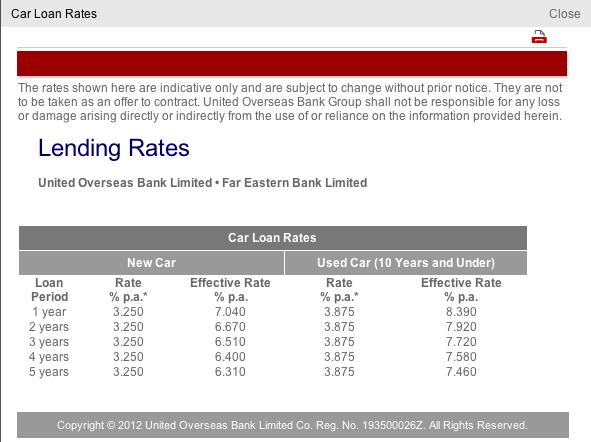
    So one of the predictions have already come true: Bank interests are up across the board. Here’s the new rates from UOB:

    The Public Transport Woes

    Many people are complaining that the new rules does not help middle income Singaporeans at all. I can empathize with them, and I can also understand why.

    A lot of my friends were driven away from public transport in the recent years because the situation has gotten really bad. In fact back in 2007 when I got my first car it was already bad. I had to commute from Bukit Batok to Tanjong Pagar and it was a crazy squeeze at the Bukit Batok station (second last stop of the North-South line) and then again at Jurong East.

    Many bit the bullet and got themselves a private transport. Truth is that the intangible benefits of car ownership can never be quantified in dollars and cents. Public transport/taxi will always be cheaper. The minimum expenditure for any car in Singapore works out to at least S$1,000 per month even if the installments are only $200. That is because running costs like insurance, road tax, parking and fuel make up about $700-800/mth. Running costs don’t vary much from car to car (unless you drive something with a big engine).

    But for those who are priced out of the market by the new rules, hang in there. More MRT lines are coming in the next few years and the government has promised to increase bus capacity. I have some confidence that they will deliver as promised.

    Used car dealers in trouble?

    This cut is very drastic. I can understand why used car dealers are complaining and coming up with alternative ways to circumvent the rules. I mentioned in the earlier blog entry that a lot of dealers took in cars at inflated prices over the past two years. Not many car dealers are cash-rich and leverage on special-rate financing for their stocks. It will not be a surprise if even big dealers wind up in the next few months.

    Hey, did we just mention leverage again? Ah, the woes of credit.

    Will MAS review this policies?

    Given the amount of noise the car dealers are making — not because they can’t find buyers but probably because all their stocks are now grossly overpriced — MAS may adjust this policy sooner than I initially suspected. If there’s adjustments, I think loan-to-value (LTV) ratio might increase by 10%.

    A bubble was growing

    I did predict a COE bubble back in 2011, albeit not in the same way that it happened. The government probably saw it coming.

    The same results, though, will apply here. I quote:

    Used car dealers will eventually be stuck with excess stock and there will be price war. A few used car dealers may even wind down due to inability to pay the financing for the cars in their showroom (they are usually on loan). Some people who lost money in the recent downward spiral of the stock market would also be forced to sell or auction their cars for cheap.

    When all these happens the prices of used cars will start to come down. People will then again flock to the used cars. But there isn’t enough new car buyers to trade in their old cars. New car dealers will be in trouble when this happens and down comes the price of COE.

    Used car dealers have had a good time for the past two years, and they created a bubble of their own by over-inflating car prices. So the question is to die now or to die later? When COE hits $100K I think would be the breaking point but it never happened.

    COE $1 a possibility

    That said, COE prices will still take a plunge. The Cat B plunge might be more drastic than Cat A due to the higher prices of Cat B cars making them out of reach to a lot of prospective buyers. There may be possibility that we’ll see $1 COE in the coming months before buyer confidence regains, so those with cars expiring in the next two years (2013-2015), prepare some cash to renew your COE when this opportunity comes. It will not come everyday.

    To wait or not to wait

    If you are still seriously considering a car, the big question is to wait or not to wait? Here’s what I think: If you are going to buy a really cheap car (under $30K) then go ahead and buy it now, provided you have done your finances. Get the car and be done with it. I think cheap cars will be snapped up really quickly as soon as the COE prices reveal its new level.

    If you are waiting to buy a higher priced car, especially something above S$100K, then hold on to your horses. You may be in for a surprise.

    Rules of affordability

    If you are still thinking of a car and unsure of whether you can afford it or not, my rules are simple.

    You either pay it full in cash, or if it is too expensive to pay in cash and you prefer to leverage, then leverage to a point whereby you are able to dispose it and stomach the loss. This 40%/50% rule makes it a no-brainer. Notice I used the word prefer, not have to, because if you have to leverage, then high chances are that you cannot afford it. It’s that simple.

    It’s a pity I am not that savvy with other markets, especially property. I would have made big bucks.

    P.S. One of the article quotes a buyer who says he can’t buy a BMW M3 and because of that wants to migrate can go and die.

  • The truth about offsetting loans with investments

    I’ve often heard people say it is easy to overcome the low car loan interest rates. While it may be 1.88%, the effective interest rate is much higher than that, about 4%.

    And people will tell me that it is easy to find something with an interest yield of 4%.

    I tell them their maths fail. Why?

    Disregarding all risks and investment yield fluctuations, simple arithmetic says that one must invest the same amount over the same period of time as the loan quantum to yield the same returns.

    This means if you took a $100K loan for 8 years, you need to plonk $100K into an investment yielding the same interest rates for 8 years.