Tag: COE

  • Budget 2013 and what it means to the Singapore Car Buyer, part 2

    This is a continuum to my earlier post: Budget 2013 and what it means to the Singapore Car Buyer.

    Bank interests up

    So one of the predictions have already come true: Bank interests are up across the board. Here’s the new rates from UOB:
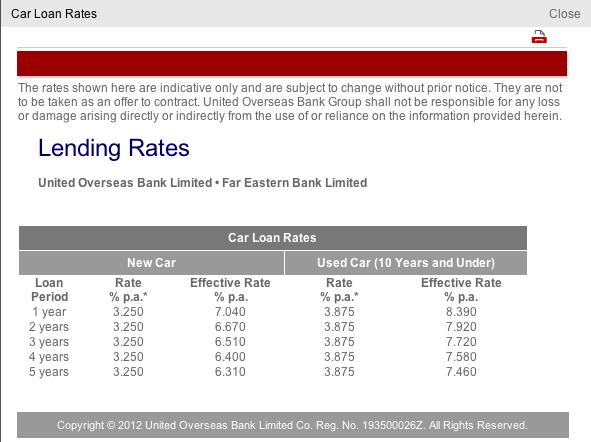
    The Public Transport Woes

    Many people are complaining that the new rules does not help middle income Singaporeans at all. I can empathize with them, and I can also understand why.

    A lot of my friends were driven away from public transport in the recent years because the situation has gotten really bad. In fact back in 2007 when I got my first car it was already bad. I had to commute from Bukit Batok to Tanjong Pagar and it was a crazy squeeze at the Bukit Batok station (second last stop of the North-South line) and then again at Jurong East.

    Many bit the bullet and got themselves a private transport. Truth is that the intangible benefits of car ownership can never be quantified in dollars and cents. Public transport/taxi will always be cheaper. The minimum expenditure for any car in Singapore works out to at least S$1,000 per month even if the installments are only $200. That is because running costs like insurance, road tax, parking and fuel make up about $700-800/mth. Running costs don’t vary much from car to car (unless you drive something with a big engine).

    But for those who are priced out of the market by the new rules, hang in there. More MRT lines are coming in the next few years and the government has promised to increase bus capacity. I have some confidence that they will deliver as promised.

    Used car dealers in trouble?
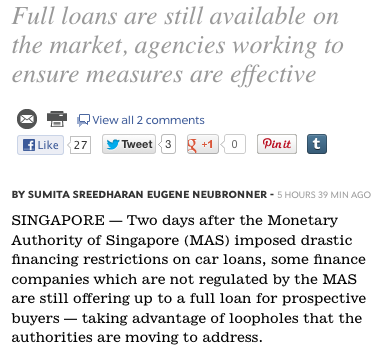
    This cut is very drastic. I can understand why used car dealers are complaining and coming up with alternative ways to circumvent the rules. I mentioned in the earlier blog entry that a lot of dealers took in cars at inflated prices over the past two years. Not many car dealers are cash-rich and leverage on special-rate financing for their stocks. It will not be a surprise if even big dealers wind up in the next few months.

    Hey, did we just mention leverage again? Ah, the woes of credit.

    Will MAS review this policies?

    Given the amount of noise the car dealers are making — not because they can’t find buyers but probably because all their stocks are now grossly overpriced — MAS may adjust this policy sooner than I initially suspected. If there’s adjustments, I think loan-to-value (LTV) ratio might increase by 10%.

    A bubble was growing

    I did predict a COE bubble back in 2011, albeit not in the same way that it happened. The government probably saw it coming.

    The same results, though, will apply here. I quote:

    Used car dealers will eventually be stuck with excess stock and there will be price war. A few used car dealers may even wind down due to inability to pay the financing for the cars in their showroom (they are usually on loan). Some people who lost money in the recent downward spiral of the stock market would also be forced to sell or auction their cars for cheap.

    When all these happens the prices of used cars will start to come down. People will then again flock to the used cars. But there isn’t enough new car buyers to trade in their old cars. New car dealers will be in trouble when this happens and down comes the price of COE.

    Used car dealers have had a good time for the past two years, and they created a bubble of their own by over-inflating car prices. So the question is to die now or to die later? When COE hits $100K I think would be the breaking point but it never happened.

    COE $1 a possibility

    That said, COE prices will still take a plunge. The Cat B plunge might be more drastic than Cat A due to the higher prices of Cat B cars making them out of reach to a lot of prospective buyers. There may be possibility that we’ll see $1 COE in the coming months before buyer confidence regains, so those with cars expiring in the next two years (2013-2015), prepare some cash to renew your COE when this opportunity comes. It will not come everyday.

    To wait or not to wait

    If you are still seriously considering a car, the big question is to wait or not to wait? Here’s what I think: If you are going to buy a really cheap car (under $30K) then go ahead and buy it now, provided you have done your finances. Get the car and be done with it. I think cheap cars will be snapped up really quickly as soon as the COE prices reveal its new level.

    If you are waiting to buy a higher priced car, especially something above S$100K, then hold on to your horses. You may be in for a surprise.

    Rules of affordability

    If you are still thinking of a car and unsure of whether you can afford it or not, my rules are simple.

    You either pay it full in cash, or if it is too expensive to pay in cash and you prefer to leverage, then leverage to a point whereby you are able to dispose it and stomach the loss. This 40%/50% rule makes it a no-brainer. Notice I used the word prefer, not have to, because if you have to leverage, then high chances are that you cannot afford it. It’s that simple.

    It’s a pity I am not that savvy with other markets, especially property. I would have made big bucks.

    P.S. One of the article quotes a buyer who says he can’t buy a BMW M3 and because of that wants to migrate can go and die.

  • Budget 2013 and what it means to the Singapore Car Buyer

    Many interesting debates sparked off when the Singapore Budget 2013 was released, but it seems the change in regulation related to the local automotive industry made the biggest impact, especially to those who have been waiting and waiting to buy a car. Those who thought there would be high number of de-registrations resulting in more COE quota and thus lower COE prices come 2016 — it came early, albeit with a twist.

    Increase in ARF

    See article: Budget 2013: New tiered tax rates for cars, rebates for commercial vehicles

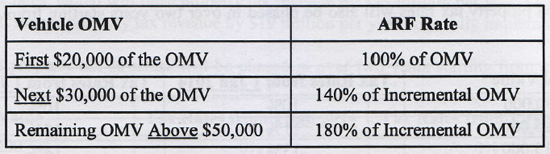
    The increase in ARF is relatively insignificant at this point unless you are buying a McLaren or Ferrari. The relative change in depreciation is only half the amount of the increase, i.e. if you are paying $10K more for ARF, the increase in depreciation is only $5K more or $500/year. This is because 50% of the ARF is refundable at the end of 10 years.

    Tightening of Financial Leverage

    See article: MAS to place cap on motor vehicle loans from Tuesday Feb 26

    No more 0% down payment and buying cars at pasar malam. Many middle income and fresh graduates are probably screaming that their dreams are busted.

    While I personally think 40-50% is quite extreme (30-40% would have been more manageable), I feel it is good that MAS placed a cap to enforce financial prudence. One should never buy an expensive car with no upfront cash.

    That said, I think there is a possibility that MAS will review these limits in another 1-2 years after the market has stabilized given the potential impact it may have on businesses.

    What about used cars?

    From my limited understanding, used cars are subject to the same terms: Maximum 5 years and at least 40% or 50% down payment (depending on OMV at time of registration). This means if you buy a 5 year old car, you can take a full 5 year loan with a 40% or 50% cash outlay.

    So what does this mean for the car buyer?

    Here’s what I think:

    • COE prices will drop by applying simple supply-demand mechanics; I am guessing to 2010-2011 levels or between $30-60K. This also means that new car prices will drop across the board except for very high end luxury cars with OMV exceeding $80K.
    • Loan interests will go up. The supply-demand concept does not work for auto loans because the demand is relatively inelastic. Recall in 2008 interest rates were 2.8% despite cars being cheap and demand being high. With the new rules banks lose up to 75% of their revenue and will find ways to recover them.
    • Cashback schemes and overtrades will be back with a vengeance. Interest rates for these schemes may go up to 6%.
    • Used car prices will also follow the drop in tandem with new car prices, albeit with a delay. A lot of used car dealers took in cars at inflated values over the past few years. They will have to let their overpriced stocks erode. So my advice is to wait a bit.
    • Relatively new cars purchased between late 2010 to early 2013 will suddenly lose their resale value as COE prices tumble. Owners of these cars will have to hold on to their cars longer before selling. Car modification workshops will huat.
    • Used cars above 4 years of age suddenly becomes very attractive. People who are tight on finances should look to buy older cars with much lesser initial outlay.
    • There is a possibility that older car prices start to rise due to the increased demand caused by lower cash outlay.
    • COE renewal will become viable as COE prices tumble. The cash outlay for a COE renewal versus down payment for a new car are going to match up really close. We will start to see a lot of old Nissan Sunny and Mitsubishi Lancers. Repair workshops will huat.
    • Hopefully prices of motor insurance will drop due to reduced car prices, but I think that would be fat hope.

    What can I afford?

    That said, can a person with about $8-10K of cash to spare still buy a car? Yes he/she can. A small hatchback from 2005 will give him/her an extremely low monthly installments at only S$200+.

    Now that is much more financially sound.

    In summary, the government is telling you that when COE drops to $30K it’s not for you to go buy a Ferrari, and that with S$5K in your bank don’t go and buy car.

  • Cyclists: Road or Pavement?

    After some recent news about cyclists being run over by cars, people started saying things like cars pay for road tax, COE, ERP and hence cyclists need to stay off the road. Cyclists then start saying that their bikes don’t wear off the road. WTF?!

    See this forum discussion.

    I think some people are just damn narrow minded. It’s not about road tax, ERP or COE. It’s about your own safety when cycling.

    Law says you can ride on the road. It does not say you *must* ride on the road if you feel it’s not safe. There are park connectors. Hell screw it, even if there’s no park connectors I will *still* choose to ride on the pavement.

    Same goes for nobody says you *can* walk on the road, but some people still choose to walk on the road.

    And some cocks still choose to cycle 2 abreast on a busy or narrow road. I know the law says you *can*, doesn’t mean you *should*. This shows how selfish people can get. Bicycles are slow moving vehicles, and if you want to talk about rules of the road, then bikes should jolly well KEEP LEFT.

    I am for cycling on pavements, illegal or not.. my safety is my top priority. If the roads are too busy to cycle on, I’ll get on the pavement. On pavements bicycles should give way to human pedestrians, that’s about all we need to do for a peaceful society. I don’t know which civil service idiot said we can’t cycle on pavements. They should shoot themselves. The number of fatalities of cyclists vs. cars is certainly higher than old aunties vs. bicycles.

    Why not on the road? Because our roads are getting too crowded with bus lane and all. It poses even more danger to a cyclist AND other road users. The bicycle is slow and fragile. Riding alongside a road with bus or lorry going at twice its speed is so damn dangerous. People have to swerve to get away from crazy ass cyclists swinging left to right trying to pedal hard to keep up with road traffic speeds.

    Secondly there are lots of traffic rules to abide to when using the roads. A lot of cyclist do not follow these rules. They cycle on the road, then turn onto pedestrian crossings when they meet a red light, or simply beat the light, or turn into filter lanes, or cycle across zebra crossings. Just a few examples of the many many crazy cyclists I’ve seen.

    There’s no control over bicycles on the road. There’s no license plates to identify a person, there’s no (legislative) need to know road traffic rules to ride on the road, there’s no speed limit, no traffic camera — nothing, basically, to enforce that bicycles must adhere to traffic rules.

    And if you start telling me because you have a road bike hence you need to cycle on the road, then I can tell you I have a Ferrari and I should race on the roads too.

    It’s not always about the money. Your life is worth more than that.

  • Balloon scheme (loan) is not what it sounds like

    Addendum, Oct 2017: I have further simplified this article for the benefit of the many visitors every month. This article is one of the highest hit articles on my blog, and it is actually a bit worrisome that even banks have joined in to offer the scheme now. The MAS rules for car financing have also changed, so many of the figures have been updated to be current. Please support me by clicking on ads that interest you. It will help me keep this blog alive and allow me contribute more articles to the Singapore motoring community.

    I came across a loan scheme called the “balloon scheme” recently. Some people say this loan scheme existed a long time ago, but I have not heard of it until recently so it’s new to me.

    My first thought: “Wow, these financial tools will evolve in 101 ways just to get people to take a loan.”

    But before reading on, please take some time to understand the Singapore vehicle taxation structure. Without that knowledge, it may be difficult to understand some of the terms used here.

    So what is a Balloon Scheme?

    The Balloon Scheme is deferred payment scheme designed to reduce the monthly instalment sum. The flip side is high interest rates and a large sum to pay at the end.

    Technical details: The interest rate is applied to the full loan amount, and then the minimum PARF rebate (or “scrap value”) is deducted before dividing into monthly instalments.

    The lower monthly instalments make it seem extremely favourable especially if you are buying an old car, but I would suggest to avoid balloon schemes. Why?

    Example of calculations

    Let’s say you bought a used car for $100K and intend to get a 5-year loan for $60K. The car has a min. PARF value of $10K.

    Typical Loan Balloon Scheme
    Car price $100,000 $100,000
    Min. PARF $10,000 $10,000
    Down payment $40,000 (40%) $40,000 (40%)
    Loan amount $60,000 (60%) $60,000 (60%)
    Interests $5,640
    @ 1.88% x 5 years
    $8,040
    @ 2.68% x 5 years
    Total Instalments Payable $60,000 + $5,640
    = $65,640
    $60,000 + $8,040 – $10,000
    = $58,040
    Instalments (Monthly)  $1,094/mth $967/mth
    Final Instalment $1,094 $10,000 + $967
    = $10,967

    That’s a $127 reduction in installments! Yeah! Let’s do that balloon scheme now!

    But wait… in addition to the extra $2,400 in interests paid, there is also a final sum of $10,000.

    The implications of the final sum

    If the COE expiry coincides with the end of the loan period then it is fine because the min. PARF rebate from the government would cover the final sum, but what if…

    What if the car has several years to go?

    You will have to cough up this $10,000 to keep your car. Or you’ll have to dispose the car prematurely and you will stand to lose even more (see below).

    What if you were stuck in a bad financial situation?

    In an event that you have to dispose (i.e. sell) the car prematurely before the end of the loan term, you will likely suffer even more financial losses.

    Early disposal

    Here is an illustrated example of an early disposal/sale.

    Selling at 8th year Selling at 10th year
    Car price $100,000 $100,000
    Sale price $20,000 $10,000 (Min. PARF)
    Years 8 years 10 years
    Depreciation ($100,000 – $20,000) / 8
    = $10,000/yr
    ($100,000 – $10,000) / 10
    = $9,000/yr

    It is clear that selling the car at the 8th year would have cost the owner and additional $1,000/yr over 8 years, that is total of $8,000! This has not taken into account any financial charges and fees should the car be disposed even before the end of the loan term. (Read up on the Rule of 78 if you would like to find out more.)

    The reason for this is because an older car should depreciate less, so the price of the car dips more than it depreciates (in a straight line) as it ages. There are some specific situations, however, that this may be not true and will depend largely on market forces at the time of sale, e.g. high COE prices would result in high car prices.

    Final words

    If you have to use the balloon scheme to afford a car, chances are that you are stretching your finances.

    The two biggest purchases in our life would likely be a property and a car; but unlike property, a car in Singapore is not an asset. It depreciates in value quickly from the moment you buy it.

    My advise would be to avoid the balloon scheme and find a car that you can comfortably upkeep.

    Addendum, Oct 2014: Do also read the updated article I wrote here in 2014: How to buy a used car in Singapore


  • What does it really cost to own a car in Singapore?

    Update: Do also read the updated article I wrote here in 2014: How to buy a used car in Singapore

    OK, I read this article and felt I had to put in a few words of my own as it was not accurately represented.

    Before I move on, those who are not familiar with the basic taxation structure for cars in Singapore should read my earlier blog post.

    If you have understood the taxation structure in Singapore (I know, it’s a lot to swallow) you would realize that the author of the above article failed to take into account the minimum PARF rebate. The author also picked a car that’s way overpriced in the current market.

    Here’s the facts. A savvy car buyer would have looked at all available options. And to pick a Toyota Altis at the price of $105,988… are you out of your mind?

    Let’s take a Volkswagen Jetta. List price $115,800. Called VW, they have a $6,000 discount. So that brings the list price down to $109,800.

    The OMV of this car is $18,500, so that gives us a $9,250 PARF rebate (50% of OMV). The straight-line depreciation of the car over 10 years is hence $109,800 – $9,250 = $100,550.

    Now, that’s just the car. All taxes inclusive – GST, etc. are already priced into the list price.

    Next, the loan. Assuming if you’re buying a ~$100k+ car, you should must have some cash for downpayment. A wise tip here – at least downpay the minimum PARF rebate and don’t take a full 10 year loan or you will be in serious debt in an event you need to sell your car. If you don’t even have cash for downpayment – sorry to say but Taxi is your friend for now.

    So let’s say we take a 1.88% (compounded) loan over 8 years for the sum of $100,550, the interest works out to be ($100,550 x 1.88%) x 8 years = ~$15,123.

    Adding that to the original sum of the car you have $100,550 + $15,123 = $115,673. The monthly repayment would be $115,673 / 8 years / 12 months = ~$1,205.

    The rest is pretty straightforward… let’s use a table to add ’em up. Here’s the true month-to-month affordability of a VW Jetta 1.4 TSI as of Jan 2012. Note some variables like insurance, parking and ERP really depends on each individual’s profession and usage of the car.

    Item S$/mth
    Loan installments $1,205
    Insurance @ $2,400/yr, no NCD $200
    Road tax @ $620/yr $52
    Fuel @ 20,000 km/yr, 13km/l @ $2/l $256
    Servicing @ $800/yr $67
    Parking (HDB + Office) $200
    Others (ERP, etc.) $100
    Totals $2,080


    Now, that’s $2,080 for a VW Jetta. So by wise financial guidelines that you should not spend more than a third of your salary on a car, you (or your family) should take home at least $6,000 to buy a car like that…

    What if you (or your family) only take home $4,000 a month? Under $1,500 a month for a car… is it achievable? Answer is… YES! Pick up a 2005 Nissan Sunny for $23,800. Bargin a little bit and bring it down to maybe $23,000… and here’s the calculations.

    Actual car depreciation (2005 cars retain 55% of OMV) = $23,000 – ($13,000 x 55%) = $23,000 – $7,150 = $15,850.

    Loan = $15,850 over 3 years @ 1.88%: $15,850 (principal) + $893.94 (interest) = ~$16,744. This works out to ~$465 per month.

    Item S$/mth
    Loan installments $465
    Insurance @ $2,000/yr, no NCD $167
    Road tax @ $742/yr $62
    Fuel @ 20,000 km/yr, 9km/l @ $2/l $370
    Servicing @ $800/yr $67
    Parking (HDB + Office) $200
    Others (ERP, etc.) $100
    Totals $1,431


    I know what some of you may be thinking – it’s just $600 more a month, why not get the Jetta. Well, $600 can kill you – that’s $7,200 a year. I eat about $600 per month on average so it really makes a lot of difference. I can either eat plain bread or have good meals or I can save that and go for a crazy vacation. It’s all about balance.

    Of course on top of just plain numbers, the value of having the convenience of a car is hard to quantify – especially if you have a pregnant wife, or an old folk, or just simply need to haul that big box from Ikea.

    Public busses and trains aren’t fair comparisons as they are mass public transit and may not bring you to your doorstep. Taxis on the other hand are getting relatively expensive and inconvenient – the queue, the wait, etc.

    So if it doesn’t break your bank – for better quality of life you should consider a car.

    At the end of the day… buy wisely, drive safely. Cheers!

    – Justin

  • Used Car Prices are Coming Down

    As predicted, it’s happening. Used car prices are coming down. It may be partially due to the fear of an impending economic crisis but I believe the problem is more micro than that.

    I’ve been watching the market for a while and there are many cars sitting at the stealer(dealer)ship for months. A lot of people are selling their cars either because they want to make a quick buck or because they got an impressive overtrade for a new VW or BMW. Whatever the case is, the used vehicle population is only growing.

    Right now there’s 22,283 used passenger cars on the market in sgCarMart. There’s currently about 600,000 passenger cars on the road and that makes up nearly 4% of the car population. Based on COE current quota allocations, this is about a years’ supply of vehicle for the entire nation. If the average vehicle depreciates about $7,000, the entire used car market stands to lose a total of $13m every month.

    Let’s check back in 1-2 months and see how this vehicle population has changed.