This is a continuum to my earlier post: Budget 2013 and what it means to the Singapore Car Buyer.
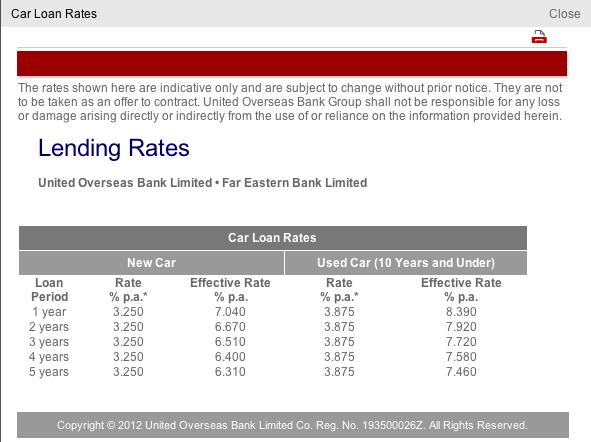
Bank interests up
So one of the predictions have already come true: Bank interests are up across the board. Here’s the new rates from UOB:
The Public Transport Woes
Many people are complaining that the new rules does not help middle income Singaporeans at all. I can empathize with them, and I can also understand why.
A lot of my friends were driven away from public transport in the recent years because the situation has gotten really bad. In fact back in 2007 when I got my first car it was already bad. I had to commute from Bukit Batok to Tanjong Pagar and it was a crazy squeeze at the Bukit Batok station (second last stop of the North-South line) and then again at Jurong East.
Many bit the bullet and got themselves a private transport. Truth is that the intangible benefits of car ownership can never be quantified in dollars and cents. Public transport/taxi will always be cheaper. The minimum expenditure for any car in Singapore works out to at least S$1,000 per month even if the installments are only $200. That is because running costs like insurance, road tax, parking and fuel make up about $700-800/mth. Running costs don’t vary much from car to car (unless you drive something with a big engine).
But for those who are priced out of the market by the new rules, hang in there. More MRT lines are coming in the next few years and the government has promised to increase bus capacity. I have some confidence that they will deliver as promised.
Used car dealers in trouble?
This cut is very drastic. I can understand why used car dealers are complaining and coming up with alternative ways to circumvent the rules. I mentioned in the earlier blog entry that a lot of dealers took in cars at inflated prices over the past two years. Not many car dealers are cash-rich and leverage on special-rate financing for their stocks. It will not be a surprise if even big dealers wind up in the next few months.
Hey, did we just mention leverage again? Ah, the woes of credit.
Will MAS review this policies?
Given the amount of noise the car dealers are making — not because they can’t find buyers but probably because all their stocks are now grossly overpriced — MAS may adjust this policy sooner than I initially suspected. If there’s adjustments, I think loan-to-value (LTV) ratio might increase by 10%.
A bubble was growing
I did predict a COE bubble back in 2011, albeit not in the same way that it happened. The government probably saw it coming.
The same results, though, will apply here. I quote:
Used car dealers will eventually be stuck with excess stock and there will be price war. A few used car dealers may even wind down due to inability to pay the financing for the cars in their showroom (they are usually on loan). Some people who lost money in the recent downward spiral of the stock market would also be forced to sell or auction their cars for cheap.
When all these happens the prices of used cars will start to come down. People will then again flock to the used cars. But there isn’t enough new car buyers to trade in their old cars. New car dealers will be in trouble when this happens and down comes the price of COE.
Used car dealers have had a good time for the past two years, and they created a bubble of their own by over-inflating car prices. So the question is to die now or to die later? When COE hits $100K I think would be the breaking point but it never happened.
COE $1 a possibility
That said, COE prices will still take a plunge. The Cat B plunge might be more drastic than Cat A due to the higher prices of Cat B cars making them out of reach to a lot of prospective buyers. There may be possibility that we’ll see $1 COE in the coming months before buyer confidence regains, so those with cars expiring in the next two years (2013-2015), prepare some cash to renew your COE when this opportunity comes. It will not come everyday.
To wait or not to wait
If you are still seriously considering a car, the big question is to wait or not to wait? Here’s what I think: If you are going to buy a really cheap car (under $30K) then go ahead and buy it now, provided you have done your finances. Get the car and be done with it. I think cheap cars will be snapped up really quickly as soon as the COE prices reveal its new level.
If you are waiting to buy a higher priced car, especially something above S$100K, then hold on to your horses. You may be in for a surprise.
Rules of affordability
If you are still thinking of a car and unsure of whether you can afford it or not, my rules are simple.
You either pay it full in cash, or if it is too expensive to pay in cash and you prefer to leverage, then leverage to a point whereby you are able to dispose it and stomach the loss. This 40%/50% rule makes it a no-brainer. Notice I used the word prefer, not have to, because if you have to leverage, then high chances are that you cannot afford it. It’s that simple.
It’s a pity I am not that savvy with other markets, especially property. I would have made big bucks.
P.S. One of the article quotes a buyer who says he can’t buy a BMW M3 and because of that wants to migrate can go and die.