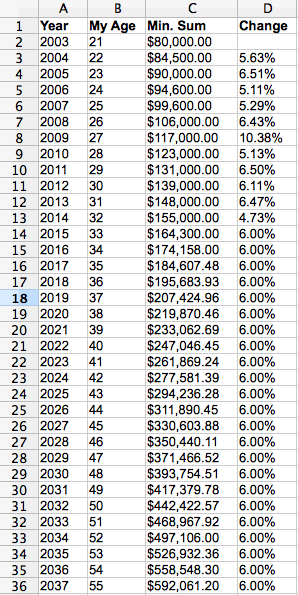
Here’s a continuation to the big CPF Minimum Sum Scheme (MSS) debate that made a record 128 comments on my Facebook wall post.
The entire debate broke up into two topics of discussion. One of them is whether CPF is good for us (vs. a welfare system) and while I do agree that CPF is generally better than having to pay high taxes for the general welfare of another misbehaving person, the other part I’m going on and on about is that the MSS is way too, urm… stringent (for the lack of a better word)?
Based on my extrapolation there is a possibility that the MSS becomes so high that a graduate making the maximum possible CPF contribution from the day he starts work at the age of 25 may never meet MSS despite not spending a single cent on property. This will continue to hold true unless some variables are changed, such as raising the $5K cap, or raising the age at which MSS computation is taken.
What happens after 55 (till 65)?
There’s a period between the time we are 55 to 65 that we’ll likely have little or no money left in our CPF OA because it all went to our RA. If people aren’t able to meet the MSS it means that *all* their OA balance will be transferred to RA and they’ll have to cough up cash for property at 55 years of age.
There is a workaround, however, and that is to fully pay off the property with any balance in the OA before one reaches 55 but not many are aware of this option.
This period between 55 to 65 is also a pretty harsh period for most people as their kids would have just entered tertiary education at around 20 years old (expensive fees) and their parents are probably also getting really old at around 80 years old (expensive healthcare). Adding a sudden property commitment could be disastrous for a family that’s already tight on financial resources.
Mortage repayments will go beyond 55
Most people around me are buying properties in their very late 20s and across their 30s. This means that their 30-year mortgage commitments will extend beyond the age of 55 and the MSS will definitely affect a lot of people.
I could continue to argue that had CPF not been allowed for property purchases, property prices wouldn’t have been this high. After all it’s money we can’t use in the near term, so people willingly spend it all on a property. However, it is also true that some people with literally no cash savings will never be able to buy a property. It’s a double edged sword, and that’s a discussion for another day.
So what good is a payout from 65 to 85 that when those who haven’t had sufficient cash savings (presumably that’s the group that the government is trying to save from dying of hunger) aren’t even sustainable 10 years prior?
Leopard will never change its spots
The second part about MSS is the question of how useful would a payout of $600+/mth be (at current MSS of $155K). I know of people who will receive $600 for the week and blow it at a horse race. Assuming if the MSS is raised to provide a payout of up to $1,000/mth, nothing would change. If they didn’t have enough money they’ll take a loan, and I’m sure moneylenders, legal or illegal, would be glad to make a hefty interest by advancing these old folk’s government payouts. Whether it is paid annually, monthly, or daily, there’s no solving this problem, really. Old habits die hard and the burden will continue to be on their children/spouse/siblings/country/state.
Those who are financially prudent will likely meet and exceed the MSS, so why let that money get stuck in CPF while they could have used it for something more important, like their kid’s education, or to fund a new business venture, or if they’re feeling generous even donate it to charity?
Thoughts on alternatives
If the MSS was meant to help those in need, then there should be criteria established to qualify for withdrawal of lump-sum CPF monies. One such example would be for emergency healthcare. If a person had cancer — a very common disease at older age, he/she should be eligible to withdraw a reasonably large percentage of all his RA monies to fund for his treatment. Similar to any form of health insurance scheme, one could surrender early — albeit possibly at a loss, but at their own discretion because not all types of diseases are covered by general health insurance schemes.
Those who are prudent and have sufficient cash savings could possibly present proof, such as a bank statement, to allow withdrawal of their CPF savings for other purposes, such as for investments, children’s educational funds, or simply to immigrate and live in a peaceful island away from Singapore. In this manner, it would also encourage people to save sufficiently before 55. Cultivating the habit of financial prudence does not occur overnight.
P.S. I just found out that there is indeed a way to exempt yourself from the MSS. To do so you must have have purchased your own annuity program or have a pension payout that is equal or more than the current MSS monthly payout. But what isn’t clear at this point (to me) is whether I am eligible to receive my CPF monies in full cash once exempted, or if there are other fine prints.