Tag: Singapore

  • Singapore’s TFR – is the Education System really the issue?

    This video is extremely on point. I am heartened to hear that the Minister is well aware of all the issues.

    It is important to distinguish between why people don’t want to have kids, versus why they don’t want to have MORE kids. I think the reasons we hear from parents about the education system is one of the key reasons why many stop at 1 or 2. Of course, housing size, general affordability, and access to private vehicle will also affect these decisions.

    People not wanting to have a child altogether is — as minister points out — often a lifestyle choice. Why give up a nice (and tidy) house just for two, a car (not a minivan), annual travels instead of tuition fees, being able to easily immigrate for job growth? These all are likely reasons some avoid having children entirely.

    I personally didn’t think that much, I just “went with the flow”. But I have to be very frank that if it wasn’t for my wife — and now my children — I would probably have left the country for career opportunities when younger. 

    That said, the points on the education system really hits home. Perhaps one thing many do not know is that the PSLE is a one-of-a-kind system in the world. No other country puts children at age 11-12 through a nationwide high stakes exam. Malaysia had something similar and also did away with it some years ago. In most parts of the world, students automatically progress to middle or secondary school without an exam. Typically, entrance exams only apply if you wanted to get into a prestigious or private school.

    PSLE was devised in early post independence Singapore because we didn’t have the capacity for every citizen to have secondary education, and also because the education standard of the nation was low, PSLE was necessary as a blunt filter.

    But today, after all the tweaks and adjustments to the system over decades, the system is probably due for overhaul. The idea that we should do away with it, or push it further, is starting to make more sense. Perhaps regular, smaller exams should be used more as a diagnostic exam, rather than a singular high-stakes selection/placement exam like PSLE. The subject-based banding subtly happens (as it does now at primary 4) at every stage — perhaps every year or two — all the way to JC.

    The video also mentions a few important points about the post-AI world, just like the post-Internet world where I grew up in: is rote memorisation and certain knowledge skills still desirable or practical? How do we teach our next generation about creativity, cross-domain synthesis, learning to learn, judgment, morals — all the “human” things that we shouldn’t be outsourcing to AI?

    Further reading: History of the Singapore Primary School Leaving Examination
  • Continuation to the CPF MSS Debate

    Here’s a continuation to the big CPF Minimum Sum Scheme (MSS) debate that made a record 128 comments on my Facebook wall post.

    The entire debate broke up into two topics of discussion. One of them is whether CPF is good for us (vs. a welfare system) and while I do agree that CPF is generally better than having to pay high taxes for the general welfare of another misbehaving person, the other part I’m going on and on about is that the MSS is way too, urm… stringent (for the lack of a better word)?

    Based on my extrapolation there is a possibility that the MSS becomes so high that a graduate making the maximum possible CPF contribution from the day he starts work at the age of 25 may never meet MSS despite not spending a single cent on property. This will continue to hold true unless some variables are changed, such as raising the $5K cap, or raising the age at which MSS computation is taken.

    What happens after 55 (till 65)?

    There’s a period between the time we are 55 to 65 that we’ll likely have little or no money left in our CPF OA because it all went to our RA. If people aren’t able to meet the MSS it means that *all* their OA balance will be transferred to RA and they’ll have to cough up cash for property at 55 years of age.

    There is a workaround, however, and that is to fully pay off the property with any balance in the OA before one reaches 55 but not many are aware of this option.

    This period between 55 to 65 is also a pretty harsh period for most people as their kids would have just entered tertiary education at around 20 years old (expensive fees) and their parents are probably also getting really old at around 80 years old (expensive healthcare). Adding a sudden property commitment could be disastrous for a family that’s already tight on financial resources.

    Mortage repayments will go beyond 55

    Most people around me are buying properties in their very late 20s and across their 30s. This means that their 30-year mortgage commitments will extend beyond the age of 55 and the MSS will definitely affect a lot of people.

    I could continue to argue that had CPF not been allowed for property purchases, property prices wouldn’t have been this high. After all it’s money we can’t use in the near term, so people willingly spend it all on a property. However, it is also true that some people with literally no cash savings will never be able to buy a property. It’s a double edged sword, and that’s a discussion for another day.

    So what good is a payout from 65 to 85 that when those who haven’t had sufficient cash savings (presumably that’s the group that the government is trying to save from dying of hunger) aren’t even sustainable 10 years prior?

    Leopard will never change its spots

    The second part about MSS is the question of how useful would a payout of $600+/mth be (at current MSS of $155K). I know of people who will receive $600 for the week and blow it at a horse race. Assuming if the MSS is raised to provide a payout of up to $1,000/mth, nothing would change. If they didn’t have enough money they’ll take a loan, and I’m sure moneylenders, legal or illegal,  would be glad to make a hefty interest by advancing these old folk’s government payouts. Whether it is paid annually, monthly, or daily, there’s no solving this problem, really. Old habits die hard and the burden will continue to be on their children/spouse/siblings/country/state.

    Those who are financially prudent will likely meet and exceed the MSS, so why let that money get stuck in CPF while they could have used it for something more important, like their kid’s education, or to fund a new business venture, or if they’re feeling generous even donate it to charity?

    Thoughts on alternatives

    If the MSS was meant to help those in need, then there should be criteria established to qualify for withdrawal of lump-sum CPF monies. One such example would be for emergency healthcare. If a person had cancer — a very common disease at older age, he/she should be eligible to withdraw a reasonably large percentage of all his RA monies to fund for his treatment. Similar to any form of health insurance scheme, one could surrender early — albeit possibly at a loss, but at their own discretion because not all types of diseases are covered by general health insurance schemes.

    Those who are prudent and have sufficient cash savings could possibly present proof, such as a bank statement, to allow withdrawal of their CPF savings for other purposes, such as for investments, children’s educational funds, or simply to immigrate and live in a peaceful island away from Singapore. In this manner, it would also encourage people to save sufficiently before 55. Cultivating the habit of financial prudence does not occur overnight.

    P.S. I just found out that there is indeed a way to exempt yourself from the MSS. To do so you must have have purchased your own annuity program or have a pension payout that is equal or more than the current MSS monthly payout. But what isn’t clear at this point (to me) is whether I am eligible to receive my CPF monies in full cash once exempted, or if there are other fine prints.

  • CPF Minimum Sum at $155K?!

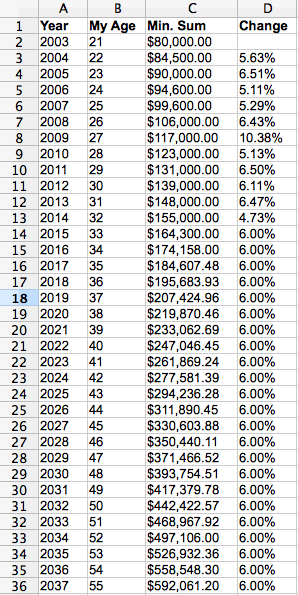
    The government just announced that the CPF minimum sum will be raised to $155K this year. Back in 2003 the min. sum was $80K.

    Minimum sum will be $600K by 2037

    Looking at this chart I came up with a very conservative 6% compound per annum, the min. sum will be almost $600K by the time I’m 55!

    I (personally) wouldn’t have met the min. sum

    Provided that I continue working till I’m 55 and am paying off my flat with CPF, I would have only accumulated approximately $370K by the time I’m 55 (including CPF interests). I’m no where near the minimum sum projection.

    The $5K max contribution limit will be raised very soon

    I strongly believe that the current max of $5K will be increased very soon because the sums just do not work out. Here’s a fictitious example of a highly paid young and energetic local graduate drawing a salary of $5K/mth so he can make the maximum possible CPF contribution from day one.

    Edit: I made some mistakes in the calculations earlier, this is an updated sheet.

    (I’m having trouble uploading graphics, will do so later.)

    He would have around $807K in his OA + SA by the time he’s 55, but check out his minimum sum! That’s provided if he doesn’t buy a property.

    But I’m sure he wants to get married and buy a flat… and have kids… the government strongly encourages that!

    He’ll have no money left in CPF if he bought a condo

    So after working for 30 years and paying for a flat together with his spouse, it is fair assumption that this bloke would have $300K less in his CPF for a decent HDB flat at current prices ($600K for a flat including interests divided equally between husband and wife).

    If the couple buys a million dollar, they will have nothing left in their OA.

    If his wife gets pregnant and stops working we may find another dead body in Bedok Reservoir/Singapore River.

    Singapore tax rate is effectively >36.5%

    Given that our current CPF rate is 36.5% (20% employee + 16.5% employer) our income tax rates can be considered to exceed 36.5%. Just as an example, the highly-paid graduate above would pay about 3% income tax for a salary of $60K/yr. This would add up to around 39.5% in taxes. This is higher than many developed countries. Even in US the highest tax bracket in the most expensive state is around 40%.

    What the hell are we still contributing to CPF? We should be contributing as little as possible.

    On hindsight, maybe it is a good idea to spend all your CPF money on a property since you’re never ever going to get it back.

    The other question would be why are we even buying older and shorter tenure properties for more money?

  • Motoring tips for wet Singapore roads

    It’s the time of the year again. Singapore gets an average of 19 rainy days and about 260-290mm of rainfall in November and December1. Flash floods and accidents are reported everywhere, as if our traffic isn’t already bad enough!

    There’s two things all drivers can do to help yourselves and help other road users.

    First, get yourself a bottle of spray-on Rain X. Don’t be one of those driving at 20km/h with hazard lights, fog lights and high beam on. It only slows traffic and makes visibility worse for other road users.

    All you need is a few pieces of newspaper. Go to a sheltered carpark. Wipe off any water with a sheet of newspaper first. Spray on Rain X generously on the front, front sides and rear windscreens. Spread/apply with newspaper. Be sure to cover the entire windscreen. Wipe clean with a new sheet of newspaper. Repeat and apply/wipe off one more time. Also apply some on side mirrors. You’ll be set for the entire month.

    Next, this is the time to get your tyres replaced if they are balding. Please don’t buy cheap or eco tyres — they have poor grip, that’s why they’re eco! Friction and fuel economy are inversely related. A lot of eco tyres are made for comfort and longevity and barely saves you any more fuel than a properly inflated tyre. Never compromise your safety for a few dollars in savings or fuel economy.

    Some tyres that are relatively quiet and known to perform well in the wet are Michelin Pilot Sport 3 (PS3) or Goodyear Eagle F1 Asymmetric (v1 and v2).

    The next thing you should check is your tyre pressure. A properly inflated tyre can make a significant difference in aquaplaning and braking performance.

    For FWD cars that are nose-heavy, I usually increase the front tyre pressure by 2-3 psi above the manufacturers’ recommended cold pressure (found on the door pillar or fuel filler cover). Most FWD cars have lower front tyre pressures to induce understeer to make their lawyers happy, but an under-inflated tyre is not good for the wet.

    A good mechanic once told me that if there’s anything you shouldn’t save on, it’s tyres, suspension and brakes.  Each tyre makes a contact patch no larger than the size of your hand. Added together, the total contact patch is no larger than an A4 sheet of paper. That’s the amount of rubber holding your 1,400kg car to the road.

    Safe motoring!

    P.S. I’ve heard people say Rain X damages wiper, etc. Seriously, wipers costs almost nothing to replace compared to a weekly tank of gas. If you keep your windscreen clean and just give your wipers a wipe down often, they should last very long. Our hot tropical climate damages wipers quickly especially when it sits under the hot sun against a dirty windscreen.

    1 Source: Climate of Singapore, from http://en.wikipedia.org/wiki/Geography_of_Singapore

  • What does it really cost to own a car in Singapore?

    Update: Do also read the updated article I wrote here in 2014: How to buy a used car in Singapore

    OK, I read this article and felt I had to put in a few words of my own as it was not accurately represented.

    Before I move on, those who are not familiar with the basic taxation structure for cars in Singapore should read my earlier blog post.

    If you have understood the taxation structure in Singapore (I know, it’s a lot to swallow) you would realize that the author of the above article failed to take into account the minimum PARF rebate. The author also picked a car that’s way overpriced in the current market.

    Here’s the facts. A savvy car buyer would have looked at all available options. And to pick a Toyota Altis at the price of $105,988… are you out of your mind?

    Let’s take a Volkswagen Jetta. List price $115,800. Called VW, they have a $6,000 discount. So that brings the list price down to $109,800.

    The OMV of this car is $18,500, so that gives us a $9,250 PARF rebate (50% of OMV). The straight-line depreciation of the car over 10 years is hence $109,800 – $9,250 = $100,550.

    Now, that’s just the car. All taxes inclusive – GST, etc. are already priced into the list price.

    Next, the loan. Assuming if you’re buying a ~$100k+ car, you should must have some cash for downpayment. A wise tip here – at least downpay the minimum PARF rebate and don’t take a full 10 year loan or you will be in serious debt in an event you need to sell your car. If you don’t even have cash for downpayment – sorry to say but Taxi is your friend for now.

    So let’s say we take a 1.88% (compounded) loan over 8 years for the sum of $100,550, the interest works out to be ($100,550 x 1.88%) x 8 years = ~$15,123.

    Adding that to the original sum of the car you have $100,550 + $15,123 = $115,673. The monthly repayment would be $115,673 / 8 years / 12 months = ~$1,205.

    The rest is pretty straightforward… let’s use a table to add ’em up. Here’s the true month-to-month affordability of a VW Jetta 1.4 TSI as of Jan 2012. Note some variables like insurance, parking and ERP really depends on each individual’s profession and usage of the car.

    Item S$/mth
    Loan installments $1,205
    Insurance @ $2,400/yr, no NCD $200
    Road tax @ $620/yr $52
    Fuel @ 20,000 km/yr, 13km/l @ $2/l $256
    Servicing @ $800/yr $67
    Parking (HDB + Office) $200
    Others (ERP, etc.) $100
    Totals $2,080


    Now, that’s $2,080 for a VW Jetta. So by wise financial guidelines that you should not spend more than a third of your salary on a car, you (or your family) should take home at least $6,000 to buy a car like that…

    What if you (or your family) only take home $4,000 a month? Under $1,500 a month for a car… is it achievable? Answer is… YES! Pick up a 2005 Nissan Sunny for $23,800. Bargin a little bit and bring it down to maybe $23,000… and here’s the calculations.

    Actual car depreciation (2005 cars retain 55% of OMV) = $23,000 – ($13,000 x 55%) = $23,000 – $7,150 = $15,850.

    Loan = $15,850 over 3 years @ 1.88%: $15,850 (principal) + $893.94 (interest) = ~$16,744. This works out to ~$465 per month.

    Item S$/mth
    Loan installments $465
    Insurance @ $2,000/yr, no NCD $167
    Road tax @ $742/yr $62
    Fuel @ 20,000 km/yr, 9km/l @ $2/l $370
    Servicing @ $800/yr $67
    Parking (HDB + Office) $200
    Others (ERP, etc.) $100
    Totals $1,431


    I know what some of you may be thinking – it’s just $600 more a month, why not get the Jetta. Well, $600 can kill you – that’s $7,200 a year. I eat about $600 per month on average so it really makes a lot of difference. I can either eat plain bread or have good meals or I can save that and go for a crazy vacation. It’s all about balance.

    Of course on top of just plain numbers, the value of having the convenience of a car is hard to quantify – especially if you have a pregnant wife, or an old folk, or just simply need to haul that big box from Ikea.

    Public busses and trains aren’t fair comparisons as they are mass public transit and may not bring you to your doorstep. Taxis on the other hand are getting relatively expensive and inconvenient – the queue, the wait, etc.

    So if it doesn’t break your bank – for better quality of life you should consider a car.

    At the end of the day… buy wisely, drive safely. Cheers!

    – Justin

  • Used Car Prices are Coming Down

    As predicted, it’s happening. Used car prices are coming down. It may be partially due to the fear of an impending economic crisis but I believe the problem is more micro than that.

    I’ve been watching the market for a while and there are many cars sitting at the stealer(dealer)ship for months. A lot of people are selling their cars either because they want to make a quick buck or because they got an impressive overtrade for a new VW or BMW. Whatever the case is, the used vehicle population is only growing.

    Right now there’s 22,283 used passenger cars on the market in sgCarMart. There’s currently about 600,000 passenger cars on the road and that makes up nearly 4% of the car population. Based on COE current quota allocations, this is about a years’ supply of vehicle for the entire nation. If the average vehicle depreciates about $7,000, the entire used car market stands to lose a total of $13m every month.

    Let’s check back in 1-2 months and see how this vehicle population has changed.