Tag: CPF

  • One year of financial progress; Tracking your net worth

    One year of financial progress; Tracking your net worth

    I’ve made effort to track my expenses over the last few years. This meant keeping a record every time I took money or a credit card out of my wallet. It is a tedious process, and gets sloppy at times.

    At the beginning of this year I set out to track my finances a little differently; I started tracking my total net worth month-to-month. Tracking net worth is much easier than tracking expenses because you only need to do it once a month. The difference, however, is that tracking net worth does not give you visibility into where exactly money is spent, e.g. food, entertainment, transport, etc.

    This is how I do it: At every start of the month, after I get my salary but before I pay my credit card bills, I keep a record of the following in an excel sheet: –

    1. Net present value of resident property less outstanding loan
    2. Net present value of investment property less outstanding loan
    3. Net present value of other assets (e.g. cars) less outstanding loan
    4. Net present value of other liquid investments, e.g. stocks, bonds, endowment, etc.
    5. Net present value of any high value personal items, e.g. jewelry
    6. Outstanding credit card debts, or other unsecured credit facilities (if any)
    7. Total cash in bank
    8. Total balance in CPF account

    * For illiquid assets, e.g. cars and jewelry, apply a fair discount of between 10-30% to its NPV.

    Then, I would create three different totals: –

    • Total of 1-8 (everything)
    • Total of 1-7 (everything except CPF)
    • Total of 2-7 (everything except CPF and resident property)

    The reason for breaking up three totals is because I do not consider CPF and residence as liquid. This will give me a good idea if I am cash rich or (illiquid) asset rich.

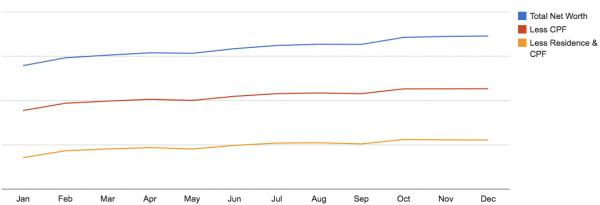
    Over a one year period, a graph like this is promising.
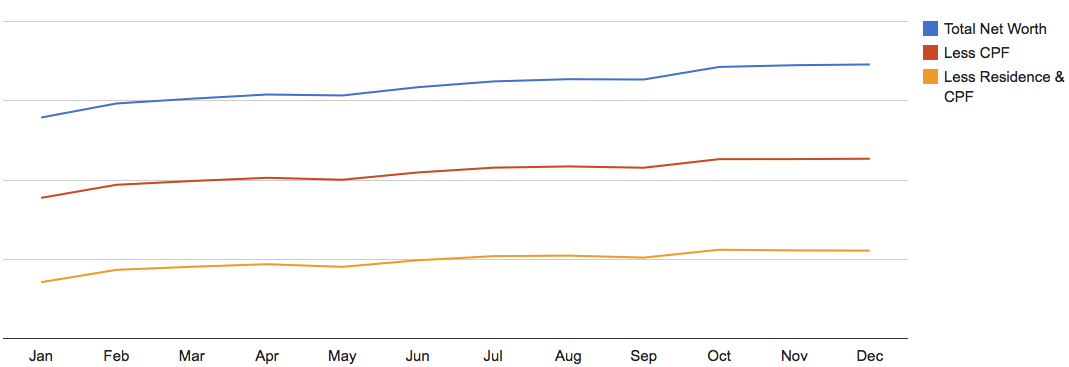
    Net Worth 2014

    There’s two things to note: –

    • The general trend of the graphs. If they trend upwards, I am making good progress, i.e. earning more than I spend. If they trend downwards, I am in trouble.
    • The gap between the yellow and blue lines. If this gap widens a lot, and especially if the blue line trends upwards while the yellow line starts to trend downwards, it means I may be spending too much on a potentially illiquid asset (residence) and should do something about it.

    Remember an article in The Straits Times about Singaporeans being asset rich and cash poor? I think the missing point here is that the problem only arises if the asset is illiquid. If the asset is liquid, it wouldn’t be a problem, e.g. a retiree could sell an investment property to fund his retirement.

    For those who have investments and assets, it is a good idea to start tracking your net worth to see if your asset is indeed an asset or liability. If done correctly, you should see vehicles losing value while your properties gaining value month-on-month.

    But if you have not even started tracking your expenses, you should start doing so before tracking your net worth, because detailed expense tracking will help you see where money is going so you can trim unnecessary areas of high expenditure, e.g. shopping.

    With that, I wish all my readers a happy, healthy and prosperous 2015!
  • Continuation to the CPF MSS Debate

    Here’s a continuation to the big CPF Minimum Sum Scheme (MSS) debate that made a record 128 comments on my Facebook wall post.

    The entire debate broke up into two topics of discussion. One of them is whether CPF is good for us (vs. a welfare system) and while I do agree that CPF is generally better than having to pay high taxes for the general welfare of another misbehaving person, the other part I’m going on and on about is that the MSS is way too, urm… stringent (for the lack of a better word)?

    Based on my extrapolation there is a possibility that the MSS becomes so high that a graduate making the maximum possible CPF contribution from the day he starts work at the age of 25 may never meet MSS despite not spending a single cent on property. This will continue to hold true unless some variables are changed, such as raising the $5K cap, or raising the age at which MSS computation is taken.

    What happens after 55 (till 65)?

    There’s a period between the time we are 55 to 65 that we’ll likely have little or no money left in our CPF OA because it all went to our RA. If people aren’t able to meet the MSS it means that *all* their OA balance will be transferred to RA and they’ll have to cough up cash for property at 55 years of age.

    There is a workaround, however, and that is to fully pay off the property with any balance in the OA before one reaches 55 but not many are aware of this option.

    This period between 55 to 65 is also a pretty harsh period for most people as their kids would have just entered tertiary education at around 20 years old (expensive fees) and their parents are probably also getting really old at around 80 years old (expensive healthcare). Adding a sudden property commitment could be disastrous for a family that’s already tight on financial resources.

    Mortage repayments will go beyond 55

    Most people around me are buying properties in their very late 20s and across their 30s. This means that their 30-year mortgage commitments will extend beyond the age of 55 and the MSS will definitely affect a lot of people.

    I could continue to argue that had CPF not been allowed for property purchases, property prices wouldn’t have been this high. After all it’s money we can’t use in the near term, so people willingly spend it all on a property. However, it is also true that some people with literally no cash savings will never be able to buy a property. It’s a double edged sword, and that’s a discussion for another day.

    So what good is a payout from 65 to 85 that when those who haven’t had sufficient cash savings (presumably that’s the group that the government is trying to save from dying of hunger) aren’t even sustainable 10 years prior?

    Leopard will never change its spots

    The second part about MSS is the question of how useful would a payout of $600+/mth be (at current MSS of $155K). I know of people who will receive $600 for the week and blow it at a horse race. Assuming if the MSS is raised to provide a payout of up to $1,000/mth, nothing would change. If they didn’t have enough money they’ll take a loan, and I’m sure moneylenders, legal or illegal,  would be glad to make a hefty interest by advancing these old folk’s government payouts. Whether it is paid annually, monthly, or daily, there’s no solving this problem, really. Old habits die hard and the burden will continue to be on their children/spouse/siblings/country/state.

    Those who are financially prudent will likely meet and exceed the MSS, so why let that money get stuck in CPF while they could have used it for something more important, like their kid’s education, or to fund a new business venture, or if they’re feeling generous even donate it to charity?

    Thoughts on alternatives

    If the MSS was meant to help those in need, then there should be criteria established to qualify for withdrawal of lump-sum CPF monies. One such example would be for emergency healthcare. If a person had cancer — a very common disease at older age, he/she should be eligible to withdraw a reasonably large percentage of all his RA monies to fund for his treatment. Similar to any form of health insurance scheme, one could surrender early — albeit possibly at a loss, but at their own discretion because not all types of diseases are covered by general health insurance schemes.

    Those who are prudent and have sufficient cash savings could possibly present proof, such as a bank statement, to allow withdrawal of their CPF savings for other purposes, such as for investments, children’s educational funds, or simply to immigrate and live in a peaceful island away from Singapore. In this manner, it would also encourage people to save sufficiently before 55. Cultivating the habit of financial prudence does not occur overnight.

    P.S. I just found out that there is indeed a way to exempt yourself from the MSS. To do so you must have have purchased your own annuity program or have a pension payout that is equal or more than the current MSS monthly payout. But what isn’t clear at this point (to me) is whether I am eligible to receive my CPF monies in full cash once exempted, or if there are other fine prints.

  • CPF Minimum Sum at $155K?!

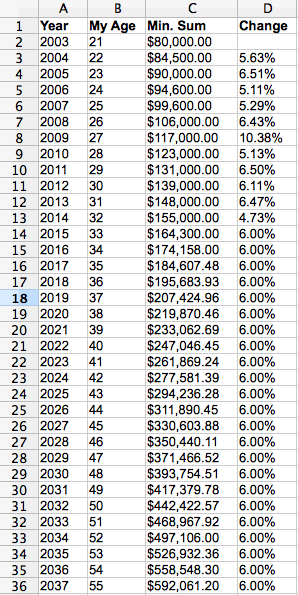
    The government just announced that the CPF minimum sum will be raised to $155K this year. Back in 2003 the min. sum was $80K.

    Minimum sum will be $600K by 2037

    Looking at this chart I came up with a very conservative 6% compound per annum, the min. sum will be almost $600K by the time I’m 55!

    I (personally) wouldn’t have met the min. sum

    Provided that I continue working till I’m 55 and am paying off my flat with CPF, I would have only accumulated approximately $370K by the time I’m 55 (including CPF interests). I’m no where near the minimum sum projection.

    The $5K max contribution limit will be raised very soon

    I strongly believe that the current max of $5K will be increased very soon because the sums just do not work out. Here’s a fictitious example of a highly paid young and energetic local graduate drawing a salary of $5K/mth so he can make the maximum possible CPF contribution from day one.

    Edit: I made some mistakes in the calculations earlier, this is an updated sheet.

    (I’m having trouble uploading graphics, will do so later.)

    He would have around $807K in his OA + SA by the time he’s 55, but check out his minimum sum! That’s provided if he doesn’t buy a property.

    But I’m sure he wants to get married and buy a flat… and have kids… the government strongly encourages that!

    He’ll have no money left in CPF if he bought a condo

    So after working for 30 years and paying for a flat together with his spouse, it is fair assumption that this bloke would have $300K less in his CPF for a decent HDB flat at current prices ($600K for a flat including interests divided equally between husband and wife).

    If the couple buys a million dollar, they will have nothing left in their OA.

    If his wife gets pregnant and stops working we may find another dead body in Bedok Reservoir/Singapore River.

    Singapore tax rate is effectively >36.5%

    Given that our current CPF rate is 36.5% (20% employee + 16.5% employer) our income tax rates can be considered to exceed 36.5%. Just as an example, the highly-paid graduate above would pay about 3% income tax for a salary of $60K/yr. This would add up to around 39.5% in taxes. This is higher than many developed countries. Even in US the highest tax bracket in the most expensive state is around 40%.

    What the hell are we still contributing to CPF? We should be contributing as little as possible.

    On hindsight, maybe it is a good idea to spend all your CPF money on a property since you’re never ever going to get it back.

    The other question would be why are we even buying older and shorter tenure properties for more money?

  • And so it’s decided

    I don’t understand why we still have MBT and TPL in Parliament. Screw the GRC system, each candidate should be opposed one-on-one. Singapore today is mature enough to not make race or religion a deciding factor.

    Workers Party, please do us proud. I offer my 2 cents:

    Abolish the CPF installment payments starting at 62 years of age – it does not benefit the poor at all. Not many of them live till that age. The statistics are flawed. Only the rich get to receive this money.

    Please don’t raise the HDB income ceiling already – it will encourage more rich people to buy and further inflate the flat prices.

    Instead, stagger the income ceiling based on the flat type, i.e. bigger flat bigger ceiling so the higher income group don’t contend with the lower income group with the 4-room flats causing it to rise much faster than the rest.

    Lower the income ceiling for PRs – this will encourage the well-to-do PRs to either rent (good for Singaporeans) or buy private property at inflated and more violatile prices.

    Impose more penalties on crappy public transport operators.

    Stop the gerrymandering and grant us our rights to freedom of speech.

    Lower the crazy ministerial salaries, tax the rich, provide healthcare for the poor.

    Finally, curb the influx of foriengners that are not only taking away some low income worker’s jobs but also breaking up families.

    Create quotas for different industry segments based on supply and demand.

    I’m not saying all foreign talents should go – skilled white-collar workers that we can learn a trick or two from can stay. That’s what they are here for – they want a jumping board, trade up their knowledge for a few years. Fair and square.

  • Aging Gracefully

    Not many political discussions make it to my blog, but I think this one is worth blogging about since this actually sparked off a long discussion on Facebook.

    Wife’s friend said the problem is not with how CPF works but with Singaporeans not knowing how to age gracefully. I totally agree with this.

    There are many opinions on whether CPF is a good or bad system. Some say it is good because it forces Singaporeans to save and controls their spending during retirement, some say it’s bad because the lower income will have no CPF to start with and they are left to die, some conspiracy theories say we don’t really know if CPF even has enough money to pay out with our aging population.

    Nevermind the speculation. Let me talk about retirement.

    Retirement is a common misconception that most of us have; most people expect to work till the so-called retirement age and then all of a sudden they retire and stop working. This is the very reason why some of you have your old folks telling you things like “(they) have fed you for the past 20 years, it’s time for you to pay back.”

    I’m not against filial piety, but expecting your child to feed you through your retirement isn’t the right mentality either. A lot of people I’ve seen suffer precisely because of their warped idea of this ancient Chinese virtue – their parents decided that it’s time to retire because their children are now working and that they should be given a (hefty) monthly allowance so they can go and play mahjong, visit the casino, buy alcohol and smoke weed when their children have just barely started with their career and are still paying off their study loans. Is this right?

    People say that they worry for their future generations – that they will not be able to afford a flat, keep up with the education system and adapt to the rising costs of living in Singapore. If we continue to have such a mentality living dollar-to-dollar, spending all our money saying that we live only once, and hoping our children will one day make tonnes of money and turn you into a full-time Tai Tai, how are we helping our children ourselves by doing this to them, let alone allow our government to help us?

    I empathize with the people who are not poor by choice but poor by circumstance, but I have seen too many people poor by choice, i.e. they don’t know how to save, spend all their earnings, refuse to work, or just gamble their money away. These are the very people who just blatantly pick any topic and blame the government for their current poor state.

    Get this right guys – no government can solve this problem. If for example Singapore ceases the CPF system and start feeding and caring for these people who are “poor by choice” then the tax payers will have to bear the high taxes – typically in excess of 30% as seen by most developed nations with such schemes. Or if for example we have a minimum wage scheme, people will become unemployed as they are priced out of their value (thanks Prof Ben – insightful discussion).

    If you have worked hard for your money and you pay 30% tax just to feed these people, will you be angry?

    By then you think we’ll still find $3 chicken rice or $0.90 coffee in Singapore when wages and taxes are so high?

    For the middle sandwich class, every one of us should fend for ourselves and plan our so-called retirement which does not necessarily mean to stop working and play mahjong all day long but to continue doing something we love/enjoy as we age and hopefully (and very likely) make decent money during the process.

    For the lower income group – I’m talking about those who can’t even afford to read this article folks. If you have fucking Internet access, you are not POOR – I believe the government is there to help. Go and seek aid.

    The retirement concept is dead folks. Don’t rely on your CPF.

    FYI – just in case you are wondering, I am pretty party neutral. I don’t like the high minister pay, neither am I a Kate Spade fan. I’m not exactly pleased with the increase in CPF contribution rates either since I think it does little for our so-called retirement. I also do think a fair amount of minority party making some noise would help keep the majority ruling party on their feet. Overall, Singapore is still a very safe country and I appreciate that.