Category: Automotive

  • The truth about offsetting loans with investments

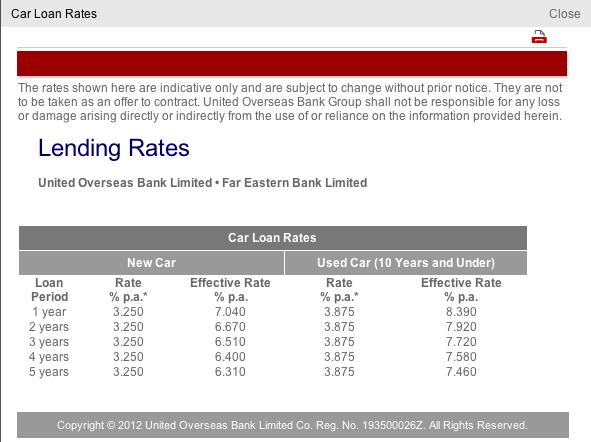
    I’ve often heard people say it is easy to overcome the low car loan interest rates. While it may be 1.88%, the effective interest rate is much higher than that, about 4%.

    And people will tell me that it is easy to find something with an interest yield of 4%.

    I tell them their maths fail. Why?

    Disregarding all risks and investment yield fluctuations, simple arithmetic says that one must invest the same amount over the same period of time as the loan quantum to yield the same returns.

    This means if you took a $100K loan for 8 years, you need to plonk $100K into an investment yielding the same interest rates for 8 years.

  • Budget 2013 and what it means to the Singapore Car Buyer

    Many interesting debates sparked off when the Singapore Budget 2013 was released, but it seems the change in regulation related to the local automotive industry made the biggest impact, especially to those who have been waiting and waiting to buy a car. Those who thought there would be high number of de-registrations resulting in more COE quota and thus lower COE prices come 2016 — it came early, albeit with a twist.

    Increase in ARF

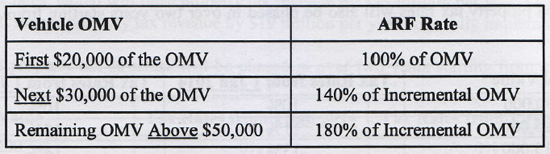
    See article: Budget 2013: New tiered tax rates for cars, rebates for commercial vehicles

    The increase in ARF is relatively insignificant at this point unless you are buying a McLaren or Ferrari. The relative change in depreciation is only half the amount of the increase, i.e. if you are paying $10K more for ARF, the increase in depreciation is only $5K more or $500/year. This is because 50% of the ARF is refundable at the end of 10 years.

    Tightening of Financial Leverage

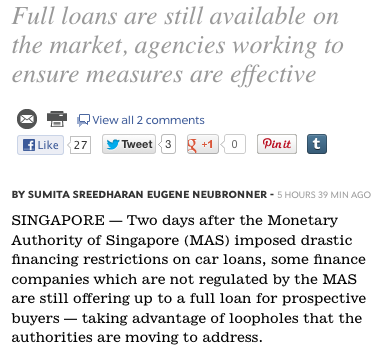
    See article: MAS to place cap on motor vehicle loans from Tuesday Feb 26

    No more 0% down payment and buying cars at pasar malam. Many middle income and fresh graduates are probably screaming that their dreams are busted.

    While I personally think 40-50% is quite extreme (30-40% would have been more manageable), I feel it is good that MAS placed a cap to enforce financial prudence. One should never buy an expensive car with no upfront cash.

    That said, I think there is a possibility that MAS will review these limits in another 1-2 years after the market has stabilized given the potential impact it may have on businesses.

    What about used cars?

    From my limited understanding, used cars are subject to the same terms: Maximum 5 years and at least 40% or 50% down payment (depending on OMV at time of registration). This means if you buy a 5 year old car, you can take a full 5 year loan with a 40% or 50% cash outlay.

    So what does this mean for the car buyer?

    Here’s what I think:

    • COE prices will drop by applying simple supply-demand mechanics; I am guessing to 2010-2011 levels or between $30-60K. This also means that new car prices will drop across the board except for very high end luxury cars with OMV exceeding $80K.
    • Loan interests will go up. The supply-demand concept does not work for auto loans because the demand is relatively inelastic. Recall in 2008 interest rates were 2.8% despite cars being cheap and demand being high. With the new rules banks lose up to 75% of their revenue and will find ways to recover them.
    • Cashback schemes and overtrades will be back with a vengeance. Interest rates for these schemes may go up to 6%.
    • Used car prices will also follow the drop in tandem with new car prices, albeit with a delay. A lot of used car dealers took in cars at inflated values over the past few years. They will have to let their overpriced stocks erode. So my advice is to wait a bit.
    • Relatively new cars purchased between late 2010 to early 2013 will suddenly lose their resale value as COE prices tumble. Owners of these cars will have to hold on to their cars longer before selling. Car modification workshops will huat.
    • Used cars above 4 years of age suddenly becomes very attractive. People who are tight on finances should look to buy older cars with much lesser initial outlay.
    • There is a possibility that older car prices start to rise due to the increased demand caused by lower cash outlay.
    • COE renewal will become viable as COE prices tumble. The cash outlay for a COE renewal versus down payment for a new car are going to match up really close. We will start to see a lot of old Nissan Sunny and Mitsubishi Lancers. Repair workshops will huat.
    • Hopefully prices of motor insurance will drop due to reduced car prices, but I think that would be fat hope.

    What can I afford?

    That said, can a person with about $8-10K of cash to spare still buy a car? Yes he/she can. A small hatchback from 2005 will give him/her an extremely low monthly installments at only S$200+.

    Now that is much more financially sound.

    In summary, the government is telling you that when COE drops to $30K it’s not for you to go buy a Ferrari, and that with S$5K in your bank don’t go and buy car.

  • Letter to my MPs on Cyclists

    Dear Mr. Liang, Ms. Sim, et al.,

    There has been some commotion after several cyclists were killed in road accidents, and after meeting with another reckless cyclists yesterday I feel I need to write to an authority about this before more people get hurt.

    I am not sure which ministry (LTA? SPF?) to send this to, hence I am writing to you.

    I recall that many years back there was an old man/lady being run over by a bicycle on pavement. Newspapers reported the incident and mentioned that bicycles are not allowed on pavements.

    Over the years it has become common knowledge that bicycles are not allowed on pavements and people have started to cycle on the roads. I am starting to see more and more people take up cycling, but these cyclists are becoming more of a nuisance and road hog, posing not only inconvenience but danger to both themselves and road users.

    I am a driver and cyclist myself and I usually cycle on pavements because I feel it is safer. I will give way to pedestrians when I meet them. Moreover my wife is not a very proficient cyclist, and I think that cycling on the road would be extremely dangerous.

    I have heard from friends that they get fined $50 for cycling on pavements, which I think is ridiculous if they weren’t cycling recklessly. Enforcement should be against any reckless cyclist, be it on the road or pavement.

    I’ve seen countless number of cyclists flout traffic rules, and here is one such incident causing an accident:
    http://singaporeseen.stomp.com.sg/stomp/sgseen/this_urban_jungle/1279106/reckless_cyclist_runs_red_light.html

    Another public video of a cyclist switching lanes recklessly at Jurong East and getting hit by a car (skip the first few seconds of the video):

    Along Woodlands Road all the way to Bukit Timah which I travel daily, the road is already very bumpy, winding and narrow due to the Downtown Line MRT construction:

    • Vehicles will need to keep an entire lane distance just to avoid the cyclists around the bends.
    • During peak hour this causes traffic jams and are a nuisance as bicycles are slow moving vehicles (20-30kph max).
    • These cyclists tend not to stop at traffic lights.

    Also, buses are very wide and use an entire lanes width. Since cyclists keep left and the left lanes are now mostly bus lanes, buses have to make bigger evasive maneuvers to avoid cyclists.

    I would like to suggest that we allow cyclists to cycle on pavements with the exception of electric bicycles which are much heavier and can go very fast (a lot of illegal ones are around nowadays).

    The rationale for my suggestion is:

    1. The probability of a pedestrian getting seriously injured being run over by a bicycle is less than having any form of motor vehicle hit a cyclist.
    2. There is no legislative requirement for cyclists to know traffic rules before they cycle on the road (e.g. basic theory test), and hence difficult to enforce.
    3. There is no legislative requirement for cyclists to be identified (e.g. number plate) and penalized for errant cycling, and hence difficult to enforce.
    4. We should not discourage people from cycling on pavements around the neighborhood. It is a cheap, green and healthy activity and can be a good family activity.
    5. I am aware that there are PCNs but the routes that PCNs take are sometimes not convenient if one uses bicycles as a mode of transport, e.g. to the market.

    Sincerely,
    Justin Lee

  • Cyclists: Road or Pavement?

    After some recent news about cyclists being run over by cars, people started saying things like cars pay for road tax, COE, ERP and hence cyclists need to stay off the road. Cyclists then start saying that their bikes don’t wear off the road. WTF?!

    See this forum discussion.

    I think some people are just damn narrow minded. It’s not about road tax, ERP or COE. It’s about your own safety when cycling.

    Law says you can ride on the road. It does not say you *must* ride on the road if you feel it’s not safe. There are park connectors. Hell screw it, even if there’s no park connectors I will *still* choose to ride on the pavement.

    Same goes for nobody says you *can* walk on the road, but some people still choose to walk on the road.

    And some cocks still choose to cycle 2 abreast on a busy or narrow road. I know the law says you *can*, doesn’t mean you *should*. This shows how selfish people can get. Bicycles are slow moving vehicles, and if you want to talk about rules of the road, then bikes should jolly well KEEP LEFT.

    I am for cycling on pavements, illegal or not.. my safety is my top priority. If the roads are too busy to cycle on, I’ll get on the pavement. On pavements bicycles should give way to human pedestrians, that’s about all we need to do for a peaceful society. I don’t know which civil service idiot said we can’t cycle on pavements. They should shoot themselves. The number of fatalities of cyclists vs. cars is certainly higher than old aunties vs. bicycles.

    Why not on the road? Because our roads are getting too crowded with bus lane and all. It poses even more danger to a cyclist AND other road users. The bicycle is slow and fragile. Riding alongside a road with bus or lorry going at twice its speed is so damn dangerous. People have to swerve to get away from crazy ass cyclists swinging left to right trying to pedal hard to keep up with road traffic speeds.

    Secondly there are lots of traffic rules to abide to when using the roads. A lot of cyclist do not follow these rules. They cycle on the road, then turn onto pedestrian crossings when they meet a red light, or simply beat the light, or turn into filter lanes, or cycle across zebra crossings. Just a few examples of the many many crazy cyclists I’ve seen.

    There’s no control over bicycles on the road. There’s no license plates to identify a person, there’s no (legislative) need to know road traffic rules to ride on the road, there’s no speed limit, no traffic camera — nothing, basically, to enforce that bicycles must adhere to traffic rules.

    And if you start telling me because you have a road bike hence you need to cycle on the road, then I can tell you I have a Ferrari and I should race on the roads too.

    It’s not always about the money. Your life is worth more than that.

  • Power Hungry

    Somebody once told me: Once you’ve driven a more powerful car, you won’t turn back. I guess thats really quite true.

    I’ve gone from my first car — a Nissan March (Micra in other countries) 1.0L to a new 1.5L Nissan and then to my current 2.0L BMW. I also used to drive my dad’s 2.4L Volvo when I first got my driving license. Power was never enough.

    The feeling of a vehicle with power on the tap is hard to describe. Many who have not driven a more powerful car may not understand and relate power with the need for speed. Of course I’m not talking about a Ferrari or a Bugatti but a normal road vehicle with sufficient power pulls you away safely in situations when you need it. In general, my personal figure is at least 100hp/tonne or more.

    I was in Melbourne a few years earlier where I rented a Holden SV6 3.6L V6 to drive up the Great Ocean Road. There were four of us and a boot full of luggages easily adding up to about 400 kilos but the car was still simply amazing to drive. It goes around the mountain roads effortlessly and merges with freeway traffic with ease.

    I specifically remember an exit from a farm road to the main freeway where I had to make a right turn (RHD in AU — which means I had to go across one direction of traffic before merging with the other). There was no way I could have waited for the right time to get on the freeway if I had been driving a 1.6L Toyota as there was simply too much traffic going at 100kph on the freeway. I waited for several minutes and found an opportunity where there was a gap in the traffic caused by a slow moving truck. I simply got on the gas and the car went right off and made the turn to merge with the traffic.

    I’ve had the opportunity to drive serveral new cars recently, namely the Audi A4 1.8T, VW Scirocco 1.4T, VW Polo 1.2T, Mini Cooper S 1.6T and the BMW 320i (F30) 2.0T. These are all amazing cars with turbocharged engines and they have loads of torque almost immediately off idle and are such a joy to drive even in our city traffic. In my opinion, there’s no reason not to consider these modern TC engines over the NA ones except for long-term reliability.

    Given the power improvements AND fuel economy, these turbo engines will be the future until a more efficient energy source after fossil fuel is found. At this point we have squeezed almost every bit of energy from gasoline and diesel. Hybrid or pure EV cars aren’t very practical yet IMHO. The need to wait a considerable amount of time to charge a battery makes it pointless. Some may argue: that’s nature and nature takes time to regenate (just like land for growing crops), but I am not at all convinced that electrical power generation is efficient given that most parts of the world still rely on some form of fossil fuel for electrical energy and the carbon footprint of setting up the entire electrical distribution infrastructure isn’t likely “CO2 friendly” either.

    Speaking of long-term reliability, modern NA engines are made of lightweight aluminium or magnesium alloys and they tend to give way under stress and heat. Weight plays a critical part in fuel economy since basic physics defines Force = Mass x Acceleration. There’s only so much force a gallon of fuel can provide and apart from reducing any frictional losses, the next step is to reduce the weight (mass) of a car. The engine is sometimes the heaviest thing in a car after the passengers (LOL) so auto manufactuers do put considable effort into reducing weight.

    The good news is that some of these modern TC engine blocks (especially VW/Audi) are still made from traditional cast iron and that might help them last longer. I am not entirely sure at this point but it seems that the BMW N20 2.0 TC engine found in 20i and 28i models of 2012 BMW vehicles (possibly also Mini Cooper S “Prince” engine) seem to be made of aluminium alloy. If that’s the case then that may be bad news given the history of the aluminium N46 engines developing gasket leaks past 60,000 kms.

    Nevertheless, most people don’t really keep their car past 5 years so auto manufacturers don’t emphasize on long term reliability like they used to in the good old 80s. Long term reliability is quite different from short term reliability. A simple example would be a transmission that could withstand loads of torque (short term) but rusts and leaks after some time (long term).

    Sometimes I wonder if all the talk about green technology gets defeated by consumerism.

    That said, one of my dream car is an old 1987+ BMW E30 320i. If I had time and money, I would almost certainly buy one and have it nicely done up. Unfortunately the car would be frowned upon by my government and I will be slapped with a 50% increase in annual road tax. Given the current COE prices, looks like I may never get to buy one unless maybe… I move out!

  • Real World Technology

    I’m leaving for Sydney later tonight and will be flying on the Airbus A380. I know we’ve heard about wing cracks on the A380 and wifey was just getting a little paranoid that we’re going to fly in a potentially cracking aircraft tonight.

    So wife’s paranoia* got me reading up on the cracks.

    * I’ll have to convince her it’s safe to fly or she’ll squeeze my arms so hard on take-off that blood just stops flowing.

    Anyway just to quickly summarize, the cracks were small hair-line cracks in the feet of ribs in the wings. This was a result of using newer, lightweight materials to save weight and improve fuel economy.

    If you make an aircraft bigger, it gets heavier so you’ll need to make the wings bigger and the engine more powerful. It’s only natural that fuel economy takes a hit.

    The automotive industry works similarly – the easier way was to make things more aerodynamic and lighter so that fuel economy improves, but with newer safety standards this is starting to become a challenge. Making an engine do more work with less fuel was the difficult part.

    The aircraft turbofan is already very efficient (at cruising speeds) but automotive fuel-saving technologies still has some ways to go. Nevertheless, the automotive industry has seen some pretty awesome new technologies in the past decade, which explains why I am such a fan of them.

    But I’m not going to talk about cars today. This brings me to another point: What drives technology?

    Technology is an integral part of our evolution and my belief is that real world needs are the main drivers of good technology. Unfortunately for the folks who would like to believe everything new is good, I do not believe its true. Good technology is not just any new technology, but technology that works to solve a real world problem – hence my love for automotive technology. In fact, old technology can sometimes be better than new technology.

    I think that aviation and automotive industries are two of the major drivers of technology; if not for space flight and aviation, we wouldn’t have GPS, accelerometers and gyroscopes in the iPhone today.

    In the recent years the automotive industry has gained a lot of traction. We’ve seen new engine technologies that improve both power and fuel efficiency, reduced emissions and new gadgets that improve safety. These are technologies put to real-world tests in everyday use, and these technologies are what I believe where the real money should be.

    Not social networking. Not group buying. Not building some iPhone app.

    Of course, these are just my personal opinions.

    In today’s fast-paced environment we are distracted by the Internet. Our thoughts are becoming more and more shallow and short-sighted. Most new technologies are built around dreams and desires rather than real needs.

    I’m not downplaying the importance of dreams but I my worry is that many are headed towards building dream/desire and we’ll soon be starved of real talents to serve our needs – and I think it’s already happening right now in our society.

    If you’re thinking of building the next big thing, give a few minutes to think about what I just wrote here.