Month: September 2020

  • Hope for humanity

    Hope for humanity

    As a kid, I was fascinated by anything that could fly – planes, helicopters, rockets. It was a privilege to be able to fly on a plane back then, as it was still relatively expensive and only middle-high income families could afford.

    In my mid twenties (around 2006), I took up remote control helicopters and planes as a hobby. I still remember I spent almost half a year learning how to hover an R/C helicopter, practicing almost every night at my void deck.

    Me flying a Multiplex EasyGlider (first generation) at Bedok Reservoir, a common place for “sloping”. R/C gliders are flown without motor power and are kept afloat by air currents.

    I wanted to attach a camera to my plane so I could get a view from above, but I was too early to the hobby and the technology wasn’t really available or was too expensive. Wireless first-person view (FPV) cameras and headsets matured several years later. By then, I was a busy working adult and dropped the hobby.

    Almost a decade later, the technology had gotten so advanced we could buy it in a single package under $1,000 as a Drone that is not only self-stabilising, but also capable of obstacle avoidance and autopilot. I unexpectedly acquired a DJI Mavic Pro in late 2017 (a story for another day), but never really gotten around flying it. Now it is practically banned everywhere.

    So why the interest in flying? When I was young, I read about the first man on the moon. I’ve always wondered how it would be like to be “flying”, and to experience weightlessness in space. I was still too young to understand what a feat it was to get to the moon back then, but my child’s recent interest in space and our solar system piqued my own interest again, so I bought a telescope and started looking up to the skies again like a curious child.

    And for the first time in my life (and my lucky kid as well) at the age of 38, I got to see Jupiter and Saturn for real.

    Some people laugh and ask: What’s the big deal? These pictures suck. We have super clear pictures of Jupiter and Saturn all over the Internet.

    Sure, but it’s different to actually see it for yourself than to see a photo on the Internet. Looking through a telescope, you know these aren’t just something you read in the book – the planets are really out there. You also get a sense of how vast space is.

    You know, people dream of many things… big house, being rich, being powerful, this and that, but I salute those (like Elon Musk) who dream of the impossible: getting the heck out of Earth, because that is a whole other level of dreaming.

    Distance between the Earth and Moon, to scale.
    (Image credits: Wikipedia)

    If you followed the SpaceX Dragon Demo-2 mission, the journey to the ISS seemed like a big trip, but the moon (384,000km) in comparison is a thousand times further than the ISS (340km). Sure, most of the effort was actually to get out of Earth’s gravity, but it’s still a long ways to the moon.

    51 years ago (1969) we landed the first man on the moon. The Apollo rockets were (mostly) hand-made. This was before we even had the Internet, when most TVs were still black and white. There were no 3D printers, no modern computer design, modelling or simulation. Everything was calculated by hand. Yet we were able to send man to the moon and back. It was so unthinkable that there were conspiracy theories.

    With all the technological and manufacturing advancements, I wonder why haven’t we developed commercial space flight earlier?

    I certainly hope we get to see commercial space travel this decade, which looks to be a reality soon.

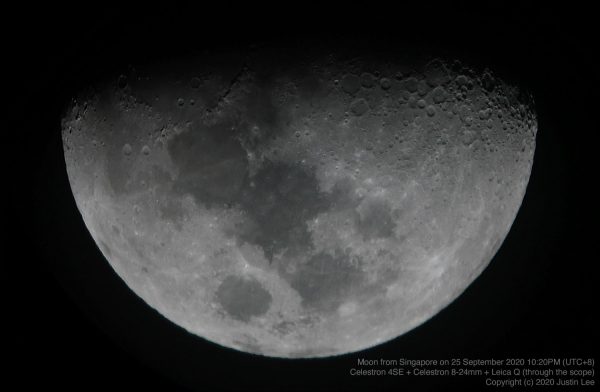
    Photo of the moon, taken from my bedroom with a Celestron 4SE telescope.

    I also hope to be alive to see the first man on Mars.

    As long as we keep trying, there’s still hope for humanity. The COVID-19 pandemic shows how important it is to be able to sustain life outside our own planet because one day another virus might just wipe all of us out.

    We need to stop fighting each other and work towards saving our own kind, and I believe that the answer is in space travel.

  • Three-piece next generation ERP unit

    Three-piece next generation ERP unit

    I read about the new 3-piece next generation ERP unit and must say I was a little bit disappointed. I applaud Transport Minister On Ye Kung for openly sharing the decision making process that lead to this design.

    As an auto enthusiast, I’ve had my fair share of IU unit failures and also personally installed various in-car accessories such as cameras, GPS, bluetooth, etc.

    I believe LTA has an expert panel, but I hope some of my opinions here can persuade the Transport Ministry to reconsider the following:

    Processing unit location

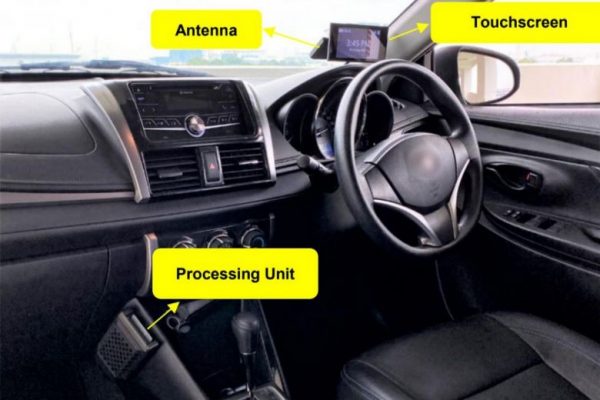
    The photo shows the unit installed on the passenger side and I certainly hope this will not be the case. It should be located under the driver’s dashboard.

    While I think it is a good idea to reduce heat by relocating the processing unit in the car, the amount of effort required to install a device across the center console can sometimes be tremendous – especially in modern cars where there’s so much equipment and cabling already in the car.

    If contractors do not wire it carefully, the wires can be tucked through areas where there may be sharp edges (e.g. metal brackets that hold the dashboard) which may lead to abrasion and eventually a wire breakage, or worse a short-circuit after years of heat and vibration.

    Also an important consideration would be cable entanglement during dashboard removal which is sometimes necessary for air-con repairs. I have seen (existing) IU wires running across from the left to the right because the power is tapped from a fusebox located on the passenger side. In situations like these, wire breakage can happen when the dashboard is removed. Luckily the existing IU uses a simple two-wire 12V DC supply. If the new ones contain a data cable (for the antenna + display), it may require a full cable replacement.

    Cabling madness in a modern BMW 5 series

    Adapter to fit Japanese vehicles that have ETC

    LTA should also consider making the in-car processing unit conform to, or be available with an adapter that may be compatible with Japanese Domestic Market vehicles with a built-in ETC device so it can be tucked away neatly in the space designed.

    Japanese ETC unit integrated into the vehicle dashboard (Credits: Wikipedia)

    It is also worth noting the small size of the 2-piece Japanese ETC 2.0 units.

    Japanese ETC unit is a 2-piece system with an external antenna and in-vehicle unit (Credits: Amazon)

    No touchscreen please

    I certainly do not encourage adding any more touch devices to distract drivers – especially taxi/private hire drivers. The automotive industry has moved away from touch to voice-control or gesture-control, and I would hope that LTA reinstate the static display – similar to that of the bike.

    Static display on a bike IU (Credits: LTA)

    No screen! Use Bluetooth + App!

    In fact, It would be a step up if the UI could be directly paired with a smartphone for the functions required and completely rely on a smartphone app. Similar to Parking.sg, wouldn’t it be awesome if I can top up and check my IU balance from my phone?

    Parking.sg app is a great move towards a paperless society (Credits: MND)

    If it can be app-enabled, then the screen can be made a removable or optional device. Simply unplug it, leaving the antenna.

    Minister Ong’s remark on smartphone: “there will be operational issues like battery running out, forgetting to bring smartphones, etc.” is also not quite valid, since most of us would have been able to charge our smartphone in our vehicles, but regardless, the IU should not be dependent on the smartphone, or vice-versa. The smartphone simply gives us access to more information where required. This is similar to many in-car cameras, where there are no displays and all actions are performed through an app.

    I understand there can be contractual obligations but if LTA can just get it right, we won’t have to go through ERP v4.0 in another 5-10 years. It’s a massive operation, and grandfathering bad designs can take a long, long time.