Tag: Interest Rates

  • How to buy a cheap(er) car: Will COE fall in 2015?

    We have an old car in the family expiring next year, and I’m sure everybody out there is wondering the same — will COE fall?

    My personal opinion is that it may fall a wee bit (Category A at around $50K) but may not fall further than that.

    Vehicle population growth rate has been reduced steadily from 3% to 1.5% to 1% and now 0.5%. I believe it may be further reduced next year, and it may possibly be capped at close to 0% growth because that’s really the limits of our infrastructure and limited land space.

    So if you are in such a situation, what’s the best way to get a cheaper car if you really need one?

    It’s actually very simple, but there’s one catch: you’ll need to pay fully in cash (no leverage).

    The trick is to buy a car with 1 year or less left on the clock, and renew when you think it’s right.

    Take for example a relatively new Jan 2013 Toyota Altis selling at close to $100K. The depreciation is about $12.5K/yr.

    If you bought an old Aug 2005 Toyota Altis at around $17K and renewed the COE (assuming current price at $66K), you will pay $17K + $66K = $83K for around 128 months of usage. This works out to a depreciation of only $7.8K/yr.

    No doubt older cars will also come with rising road tax (capped at 150%) and rising maintenance costs, and possibly even poorer fuel economy, but with the savings of almost $5K/yr you could spend that on an engine overhaul and still have spare change for a small holiday.

    If you feel that such a hefty sum of money can be better used to invest, then there’s only one way to leverage: long time owners of private properties can consider a mortgage term loan (using property as collateral) to partially finance COE renewal.

    Even if interest rates rise to 3%+ it may still be cheaper than a conventional vehicle loan because a mortgage loan is a reducing interest loan while a vehicle loan is a fixed interest loan.

    Business owners with overdraft facilities can consider too, if the vehicle is to be used for business purposes.

    I do not encourage taking a loan on the full value of COE. Although any unused amount of COE is fully redeemable, interests can get quite hefty, especially when OD interests are around 5-6%.
  • Budget 2013 and what it means to the Singapore Car Buyer

    Many interesting debates sparked off when the Singapore Budget 2013 was released, but it seems the change in regulation related to the local automotive industry made the biggest impact, especially to those who have been waiting and waiting to buy a car. Those who thought there would be high number of de-registrations resulting in more COE quota and thus lower COE prices come 2016 — it came early, albeit with a twist.

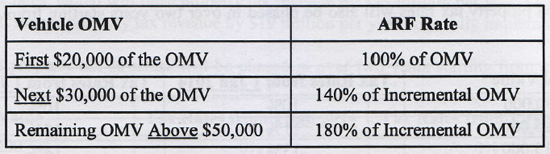
    Increase in ARF

    See article: Budget 2013: New tiered tax rates for cars, rebates for commercial vehicles

    The increase in ARF is relatively insignificant at this point unless you are buying a McLaren or Ferrari. The relative change in depreciation is only half the amount of the increase, i.e. if you are paying $10K more for ARF, the increase in depreciation is only $5K more or $500/year. This is because 50% of the ARF is refundable at the end of 10 years.

    Tightening of Financial Leverage

    See article: MAS to place cap on motor vehicle loans from Tuesday Feb 26

    No more 0% down payment and buying cars at pasar malam. Many middle income and fresh graduates are probably screaming that their dreams are busted.

    While I personally think 40-50% is quite extreme (30-40% would have been more manageable), I feel it is good that MAS placed a cap to enforce financial prudence. One should never buy an expensive car with no upfront cash.

    That said, I think there is a possibility that MAS will review these limits in another 1-2 years after the market has stabilized given the potential impact it may have on businesses.

    What about used cars?

    From my limited understanding, used cars are subject to the same terms: Maximum 5 years and at least 40% or 50% down payment (depending on OMV at time of registration). This means if you buy a 5 year old car, you can take a full 5 year loan with a 40% or 50% cash outlay.

    So what does this mean for the car buyer?

    Here’s what I think:

    • COE prices will drop by applying simple supply-demand mechanics; I am guessing to 2010-2011 levels or between $30-60K. This also means that new car prices will drop across the board except for very high end luxury cars with OMV exceeding $80K.
    • Loan interests will go up. The supply-demand concept does not work for auto loans because the demand is relatively inelastic. Recall in 2008 interest rates were 2.8% despite cars being cheap and demand being high. With the new rules banks lose up to 75% of their revenue and will find ways to recover them.
    • Cashback schemes and overtrades will be back with a vengeance. Interest rates for these schemes may go up to 6%.
    • Used car prices will also follow the drop in tandem with new car prices, albeit with a delay. A lot of used car dealers took in cars at inflated values over the past few years. They will have to let their overpriced stocks erode. So my advice is to wait a bit.
    • Relatively new cars purchased between late 2010 to early 2013 will suddenly lose their resale value as COE prices tumble. Owners of these cars will have to hold on to their cars longer before selling. Car modification workshops will huat.
    • Used cars above 4 years of age suddenly becomes very attractive. People who are tight on finances should look to buy older cars with much lesser initial outlay.
    • There is a possibility that older car prices start to rise due to the increased demand caused by lower cash outlay.
    • COE renewal will become viable as COE prices tumble. The cash outlay for a COE renewal versus down payment for a new car are going to match up really close. We will start to see a lot of old Nissan Sunny and Mitsubishi Lancers. Repair workshops will huat.
    • Hopefully prices of motor insurance will drop due to reduced car prices, but I think that would be fat hope.

    What can I afford?

    That said, can a person with about $8-10K of cash to spare still buy a car? Yes he/she can. A small hatchback from 2005 will give him/her an extremely low monthly installments at only S$200+.

    Now that is much more financially sound.

    In summary, the government is telling you that when COE drops to $30K it’s not for you to go buy a Ferrari, and that with S$5K in your bank don’t go and buy car.

  • Inflation vs Interest Rates in Singapore

    So 2010 inflation was at 2.8%, and this year the government estimates it to be at 4%.

    I’m actually wondering how these figures came about. (JJ, I know you’re reading this. Please enlighten – you can leave a private comment if you want.)

    Are property prices part of the index used to calculate inflation in Singapore? How about vehicle prices? How about the fact that CPF has raised it’s maximum monthly cap to $5,000 and increased employer contribution by 0.5%?

    My estimate is that inflation has in fact risen a good 5%-8% in 2010 and will be much higher in 2011.

    If you compare Singapore and maybe New Zealand which has similar inflation rates, the interest rates in Singapore are at a pathetic 0.06%. The interest rates in countries like Australia and New Zealand are at 3-4% – at least close to that of inflation. Even USA with an inflation rate of 1.6% in 2010 has an interest rate of 0.25% – four times that of Singapore.

    What this means is that money my bank is shrinking 3.94% every year. Forget it, make that 4%.

    So on top of putting up in an overcrowded nation and dealing with my noisy neighbours, my savings are actually shrinking. For every $10,000, that’s $400. Wow.

    If I don’t want risks and want my money to grow or at least catch up with inflation, what do I do with it?

    References:
    http://www.rttnews.com/Content/AsianEconomicNews.aspx?Node=B2&Id=1571224
    http://www.tradingeconomics.com/Economics/Stock-Market.aspx?Symbol=SGY
    http://www.tradingeconomics.com/Economics/Stock-Market.aspx?Symbol=NZD