Tag: LTA

  • Three-piece next generation ERP unit

    Three-piece next generation ERP unit

    I read about the new 3-piece next generation ERP unit and must say I was a little bit disappointed. I applaud Transport Minister On Ye Kung for openly sharing the decision making process that lead to this design.

    As an auto enthusiast, I’ve had my fair share of IU unit failures and also personally installed various in-car accessories such as cameras, GPS, bluetooth, etc.

    I believe LTA has an expert panel, but I hope some of my opinions here can persuade the Transport Ministry to reconsider the following:

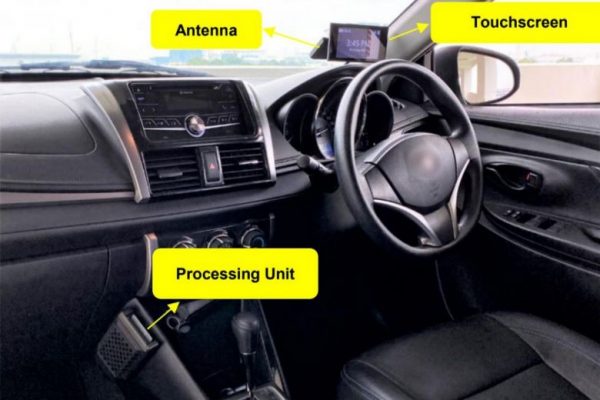
    Processing unit location

    The photo shows the unit installed on the passenger side and I certainly hope this will not be the case. It should be located under the driver’s dashboard.

    While I think it is a good idea to reduce heat by relocating the processing unit in the car, the amount of effort required to install a device across the center console can sometimes be tremendous – especially in modern cars where there’s so much equipment and cabling already in the car.

    If contractors do not wire it carefully, the wires can be tucked through areas where there may be sharp edges (e.g. metal brackets that hold the dashboard) which may lead to abrasion and eventually a wire breakage, or worse a short-circuit after years of heat and vibration.

    Also an important consideration would be cable entanglement during dashboard removal which is sometimes necessary for air-con repairs. I have seen (existing) IU wires running across from the left to the right because the power is tapped from a fusebox located on the passenger side. In situations like these, wire breakage can happen when the dashboard is removed. Luckily the existing IU uses a simple two-wire 12V DC supply. If the new ones contain a data cable (for the antenna + display), it may require a full cable replacement.
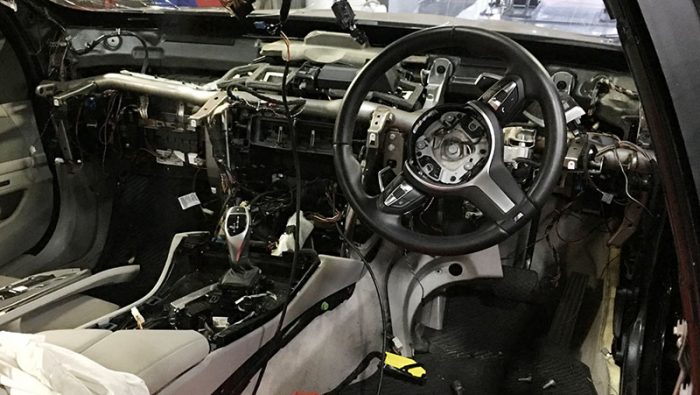
    Cabling madness in a modern BMW 5 series

    Adapter to fit Japanese vehicles that have ETC

    LTA should also consider making the in-car processing unit conform to, or be available with an adapter that may be compatible with Japanese Domestic Market vehicles with a built-in ETC device so it can be tucked away neatly in the space designed.
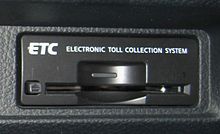
    Japanese ETC unit integrated into the vehicle dashboard (Credits: Wikipedia)

    It is also worth noting the small size of the 2-piece Japanese ETC 2.0 units.
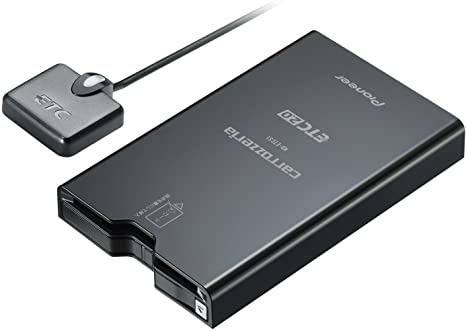
    Japanese ETC unit is a 2-piece system with an external antenna and in-vehicle unit (Credits: Amazon)

    No touchscreen please

    I certainly do not encourage adding any more touch devices to distract drivers – especially taxi/private hire drivers. The automotive industry has moved away from touch to voice-control or gesture-control, and I would hope that LTA reinstate the static display – similar to that of the bike.
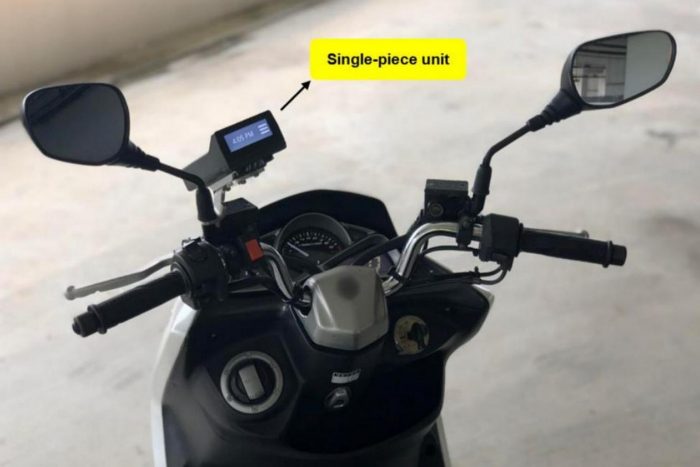
    Static display on a bike IU (Credits: LTA)

    No screen! Use Bluetooth + App!

    In fact, It would be a step up if the UI could be directly paired with a smartphone for the functions required and completely rely on a smartphone app. Similar to Parking.sg, wouldn’t it be awesome if I can top up and check my IU balance from my phone?
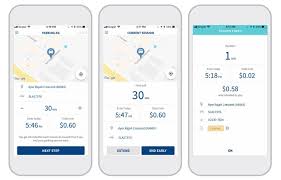
    Parking.sg app is a great move towards a paperless society (Credits: MND)

    If it can be app-enabled, then the screen can be made a removable or optional device. Simply unplug it, leaving the antenna.

    Minister Ong’s remark on smartphone: “there will be operational issues like battery running out, forgetting to bring smartphones, etc.” is also not quite valid, since most of us would have been able to charge our smartphone in our vehicles, but regardless, the IU should not be dependent on the smartphone, or vice-versa. The smartphone simply gives us access to more information where required. This is similar to many in-car cameras, where there are no displays and all actions are performed through an app.

    I understand there can be contractual obligations but if LTA can just get it right, we won’t have to go through ERP v4.0 in another 5-10 years. It’s a massive operation, and grandfathering bad designs can take a long, long time.
  • MAS eases curbs; where is COE headed

    MAS eases curbs; where is COE headed

    If you’ve been following the news, you should have heard about MAS easing the loan curbs. So where is COE headed? Most people say it will go up, but I think it will only inch up marginally.

    Reducing downpayment by 10% will help buyers reduce their upfront commitment by around $8K (for a $80K car). If COE shot up in excess of $10K, e.g. an $80K now costs $90K, it would defeat the loan curbs ($32K vs. $27K downpayment).

    The extension of loan tenure from 5 to 7 years makes monthly commitments easier on the pocket, but right now most buyers waiting on the sidelines are likely more cash strapped. Remember: it is supply and demand that causes COE prices to move.

    Also, the number of COE quota available right now actually meets or exceeds that of 2008 when COE was <$20K. With so many cars going to the scrapyards, we will see this quota sustain for quite a while. I believe this is the primary reason why the loan curbs were eased — otherwise we may see $20-30K COE by 2018. I believe the loans will be further relaxed in 2017 (to 80% + 8 years) if total quota exceeds 2,500 in each bidding. If the quota remains fairly constant, then there will be no change.

    In summary, I think COE prices will not move much… it may rise a little bit, with a little spike in the short term due to sudden demand, but should eventually stagnate around $50K for both Cat A and B.

    P.S. I can’t help but feel that LTA really screwed up on Cat A vs. B differentiation even when they had the one opportunity to do it right.

  • Peer to peer car sharing in Singapore – is it really working?

    I’ve always wanted to make car sharing possible – there are two ways to go about it.

    First method: I would announce my travel plans and pick somebody going the same way as I am. In return I will get paid a token sum to ferry my passengers. I call this “Taxi style”.

    Second method: I rent my car out for profit. In short, it’s plain old private car rental. This is actually working in the US, see RelayRides.

    One problem with private car rental in Singapore is legislative restriction. At present, private car rental is only allowed on weekends or public holidays.

    The other problem is insurance coverage. Both methods of car sharing I described are classified as using the car for hire or reward. Hire/reward is explicitly prohibited on almost, if not all, private car insurance policies.

    Believe it or not, I called almost every insurance company in Singapore trying to see if rental coverage was possible. The answer was NO. Some did cover rental fleets, but the fleet size had to be considerable and it had to be a business.

    iCarsclub collaborated with DirectAsia to get the insurance problem resolved, so it is really very interesting.

    I decided to conduct an experiment.

    I signed up as a car owner. I did some research, and listed my car up at a very reasonable rate – $7 per hour, or $55 per day.

    My friend wanted to rent my car for the weekend, so he had it for 3 days on this long weekend (May 24 to May 26).

    The catch is this – fuel costs are borne by the car owner. iCarsclub in return charges the renter for mileage ($0.30/km). The renter also needs to pay for insurance coverage ($0.40/km).

    At the end of the rental, the bill came up to $326.83. The breakdown as follows:

    • Mileage traveled: 232 km
    • Booking fee: $2.00
    • Rental fee: $165.00 ($55/day x 3)
    • Mileage charges: $69.60
    • Insurance: $86.80
    • GST: $3.43

    iCarsclub takes a 20% commission from the rental fee.

    Insurance premiums are paid to DirectAsia.

    As a car owner I would only receive rental + mileage = $201.60.

    I also had to pay for the fuel, estimated to be about $60.

    On top of that, I have to pay for the SIM card in my car tracking device. That costs $39/mth.

    The result?

    • Car owner earns: $102.60 (31%)
    • Petrol company earns: $60.00 (18%)
    • Telco company earns: $39.00 (12%)
    • Insurance company earns: $86.80 (27%)
    • iCarsclub earns: $35.00 (11%)
    • Government earns: $3.43 (1%)

    It seems like businesses are the ultimate winners here. The owner actually receives less than a third of the amount.

    As a renter, there’s no price advantage. My car is already priced very low. My friend could have rented a similar car from a rental company for equal or less without worrying about the mileage based charges killing him.

    And because of the fixed mileage charges, it gives the renter no incentive to save fuel. He could go full throttle on the car all the time, or even abuse the fuel card.

    As a car owner, I am not sure if the amount risks I expose myself to would justify the $100+.

    Every car owner would have to sign a 2-year contract with iCarsclub, so my car would remain in their inventory for another 2 years. There is also a refundable deposit of $300 I had to pay. Breaking the contract would forfeit my deposit.

    Right now I think the pricing scheme needs to be tweaked. I am trying to get in touch with them to see how it can be improved. I am also hoping LTA’s announcement to liberalize private car rental on weekdays would come true.

    I am not discouraged yet and will continue to rent my car out to see how this whole scheme works out.