Tag: Stocks

  • One year of financial progress; Tracking your net worth

    One year of financial progress; Tracking your net worth

    I’ve made effort to track my expenses over the last few years. This meant keeping a record every time I took money or a credit card out of my wallet. It is a tedious process, and gets sloppy at times.

    At the beginning of this year I set out to track my finances a little differently; I started tracking my total net worth month-to-month. Tracking net worth is much easier than tracking expenses because you only need to do it once a month. The difference, however, is that tracking net worth does not give you visibility into where exactly money is spent, e.g. food, entertainment, transport, etc.

    This is how I do it: At every start of the month, after I get my salary but before I pay my credit card bills, I keep a record of the following in an excel sheet: –

    1. Net present value of resident property less outstanding loan
    2. Net present value of investment property less outstanding loan
    3. Net present value of other assets (e.g. cars) less outstanding loan
    4. Net present value of other liquid investments, e.g. stocks, bonds, endowment, etc.
    5. Net present value of any high value personal items, e.g. jewelry
    6. Outstanding credit card debts, or other unsecured credit facilities (if any)
    7. Total cash in bank
    8. Total balance in CPF account

    * For illiquid assets, e.g. cars and jewelry, apply a fair discount of between 10-30% to its NPV.

    Then, I would create three different totals: –

    • Total of 1-8 (everything)
    • Total of 1-7 (everything except CPF)
    • Total of 2-7 (everything except CPF and resident property)

    The reason for breaking up three totals is because I do not consider CPF and residence as liquid. This will give me a good idea if I am cash rich or (illiquid) asset rich.

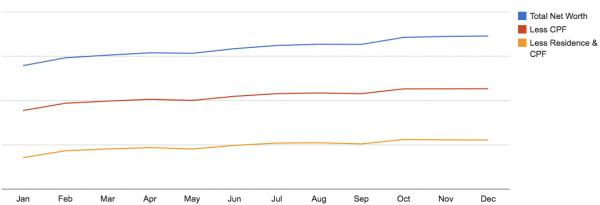
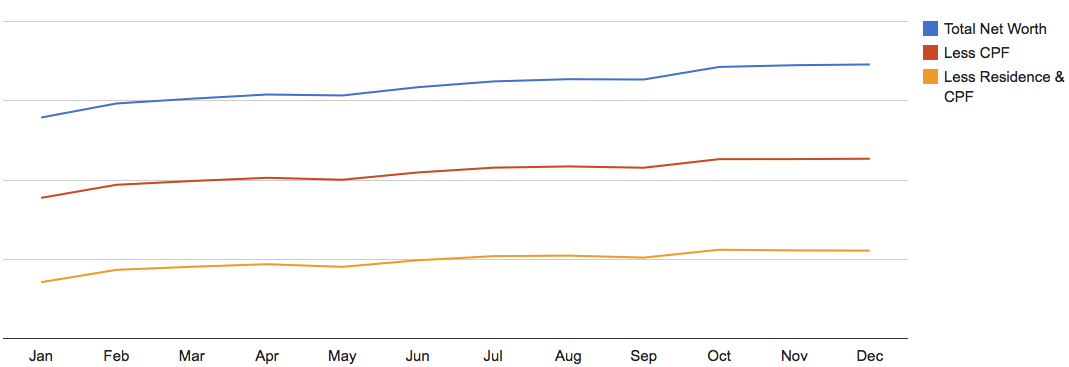
    Over a one year period, a graph like this is promising.
    Net Worth 2014

    There’s two things to note: –

    • The general trend of the graphs. If they trend upwards, I am making good progress, i.e. earning more than I spend. If they trend downwards, I am in trouble.
    • The gap between the yellow and blue lines. If this gap widens a lot, and especially if the blue line trends upwards while the yellow line starts to trend downwards, it means I may be spending too much on a potentially illiquid asset (residence) and should do something about it.

    Remember an article in The Straits Times about Singaporeans being asset rich and cash poor? I think the missing point here is that the problem only arises if the asset is illiquid. If the asset is liquid, it wouldn’t be a problem, e.g. a retiree could sell an investment property to fund his retirement.

    For those who have investments and assets, it is a good idea to start tracking your net worth to see if your asset is indeed an asset or liability. If done correctly, you should see vehicles losing value while your properties gaining value month-on-month.

    But if you have not even started tracking your expenses, you should start doing so before tracking your net worth, because detailed expense tracking will help you see where money is going so you can trim unnecessary areas of high expenditure, e.g. shopping.

    With that, I wish all my readers a happy, healthy and prosperous 2015!

  • Investment portfolio reshuffle

    Earlier I wrote about the painful (and expensive) financial lessons I learnt over the last few years. I’ve been reading books and articles and will slowly reshuffle my investment portfolio.

    My current investment portfolio looks like this:

    • My nett investments are approx. 25% of my cash, i.e. if I have $20K cash, I would have $5K of investments (total $25K).
    • Around 30% of my investments are in Prudential ILFs and not doing very well.
    • The remainder are in SGX in various stocks and REITs.

    (more…)

  • Financial Lessons

    Several times a year for the past few years I would revisit and update a spreadsheet that I created sometime back in 2010/2011 to track my (and wife’s) financials. It tracks our incomes, expenses, investments and assets and gives a projection of savings over a time horizon. Ever since we got married and bought a property in 2009 (with a loan, of course — as most Singaporeans do) I was concerned about the $200K+ property debt I had incurred; I worry that I may not be able to pay it off — let alone “retire” comfortably although I do not really buy the idea of a retirement. I believe in a working retirement, but this will be a topic for another day.

    The intent of this blog post is to share with you several expensive and painful financial management lessons I have learnt over the years. I know that it may be too late by the time people read this (as is usually the case) but hopefully those who follow my blog will be able to share their experiences or gain some good knowledge before shit hits the fan.

    This entry will be more of a summary since I will not be able to cover everything in a single post. I will try to write detailed follow-ups in the near future, and possibly also use this to track/share my investment moves and progress over time.

    A little history

    In 2009, I bought my current 5-room HDB flat with zero — yes $0 — COV. I was lucky to have bought it during a minor downturn in the property market. Even then, it was rare to buy a flat with no COV.

    Before I purchased my property, I set aside $10K of my CPF OA monies into Prudential Investment-Linked Funds (PruLink Singapore Managed Fund and PruLink Global Basics Fund). I was lucky (or maybe not) to have done this before the government imposed a minimum balance in CPF OA before money could be used for investments. The primary goal was to prevent HDB from taking all the money from my CPF OA for the property downpayment so I’ll have some rainy-day reserve. The secondary goal was to grow my money at a better rate than the prevailing CPF OA interest rate — as of this writing, 2.5% p.a..

    In 2010, I decided to speak to a friendly financial advisor on how to grow my savings. I bought into two Prudential endowment plans (PruFlexiCash and PruSave).

    In early 2011, I received a lump-sum payout from my business and once again approached my friendly financial advisor. I invested 30% of my cash savings into more Investment Linked Funds (ILF). The funds were distributed between a mix of global equities, bonds and commodities — something I thought to be very balanced and risk averse until the markets dipped in July/August 2011 right after I invested my money. FML.

    In late 2012, I finally got my online account for Prudential working and found out that my “investments” weren’t doing very well. In fact — they were in a mess. I switched several funds around to something that was relatively stable and growing — Singapore bonds.

    In 2013, I decided to buy some shares on SGX myself after realizing my Prudential “investments” were a load of bullcrap. Listening to my old man (who by the way is not your typical uncle trading tips with other uncles at the coffeeshop; he reads lots of books, of course including Warren Buffet’s book) and his theory of “it is never the wrong time to buy for the long term”, I bought into several shares between April and May. The government announced a bunch of cooling measures that killed a large % of my real estate shares and then a big market slide in September dealt a second blow. It’s the 2011 deja-vu. How unlucky can I get?

    Fast forward to 2014

    My flat has since gained approx. 38% in (unrealized) asset value but I ain’t going to sell it just yet. However if I do sell it, the nett gain after deducting interests would probably be somewhere around 25%.

    My CPF “investment” was at -36% of its original value before I switched funds in 2012. As of this writing, it has improved but is still at a miserable -32%. This is after 5 years!

    I also learnt that my endowment plans pay hefty commission charges and may possibly not yield the projected 3-7%, but forgoing it early would mean massive losses so I’m just keeping it for the sake of keeping it. Premiums paid-to-date (after exactly 4 years) are around $26K but the current value of the policies are only around $13K. That is almost 50% of losses for early surrender.

    My cash investment-linked funds from 2011 are at -8.3% its original value as of this writing. This is after waiting it out for more than 2 years. It was even worse prior to me switching to bonds in late 2012.

    My SGX shares are at -6% of its original value as of last week when STI fell below 3,000. But after adding dividends this turns out to be not too bad — my losses are around -4% nett considering that I entered at a really bad time near the peak of 2013 when STI was >3,400. I take this 4% loss as “school fees”.

    So with 4 years of crappy financial management, I asked myself if I could have done better.

    Summary of lessons learnt

    Not all debts are bad. I believe most articles on financial prudence would advise against debt, but it is near impossible for a young working couple to own a home in Singapore without a loan.

    Don’t trust your friendly financial adviser. Even if he meant well, the training he had received may not.

    Endownment plans are bullcrap unless you are the sort who does not know how to save, then it forces you to save (somewhat).

    ILFs are the ultimate garbage. The commission charges will kill you.

    As a summary of the three points above, never trust somebody else to manage your money for you… well… because it’s not their money.

    The one thing I am not sure about yet is the stock market which I will learn about and experiment with over the course of the next one year.

    Stay tuned for further updates…